

That heavy, cotton-wool feeling in your head — where thoughts feel slow, words don’t come easily, and even simple decisions feel effortful — has a name: brain fog. It’s not a medical diagnosis on its own, but it’s one of the most common complaints people bring up, and it’s frequently tied to inflammation, poor blood sugar regulation, and sluggish circulation to the brain.
The good news is that brain fog often responds surprisingly well to specific dietary changes, sometimes within days rather than weeks. Unlike focus, which is about sustaining attention on a task, brain fog is more about the underlying clarity and sharpness of your thinking itself — and it calls for a slightly different set of foods.
This guide covers 5 foods with real evidence behind clearing brain fog and restoring mental sharpness. If your main struggle is staying on task rather than feeling foggy, our 5 Best Foods to Improve Focus and Concentration guide is the better starting point. And if brain fog shows up alongside forgetfulness, pair this with our 17 Best Foods to Boost Memory and Brain Function guide.

Quick Answer
Brain fog usually comes from one of three sources: inflammation, poor blood sugar control, or sluggish circulation — and the right food depends on which is driving yours. Ginger and cinnamon both fight inflammation and help stabilize blood sugar, making them useful first steps for fog that worsens after meals. Coconut oil provides an alternative brain fuel source (ketones) that can help when glucose metabolism itself feels the problem. Peppermint offers a fast, short-term alertness boost useful for an immediate fog episode, while ginseng is better suited to longer-term mental stamina and clarity when used consistently over weeks.
Table of Contents
- What Actually Causes Brain Fog
- How to Choose the Right Foods for Your Fog
- The 5 Best Foods for Brain Fog and Mental Clarity
- Comparison Table
- Brain Fog Foods for Different Situations
- How to Build a Fog-Fighting Daily Routine
- Common Mistakes That Make Brain Fog Worse
- Expert Tips
- Final Thoughts
- FAQ
What Actually Causes Brain Fog {#what-causes-fog}
Brain fog is rarely one single thing — it’s usually the visible symptom of an underlying imbalance. The three most common drivers are low-grade inflammation, blood sugar swings, and reduced blood flow to the brain.
Chronic low-grade inflammation affects how efficiently neurons communicate, and it’s increasingly linked to the kind of persistent mental sluggishness people describe as fog rather than simple tiredness. Anti-inflammatory foods can measurably improve this over time.
Blood sugar instability is one of the most underrated fog triggers — the same post-meal glucose spike-and-crash pattern covered in our Best Foods for Insulin Resistance guide often shows up specifically as fog rather than obvious fatigue, especially 60-90 minutes after a carb-heavy meal.
Finally, your brain is unusually sensitive to blood flow changes. Even mild reductions in circulation can produce the exact “thinking through mud” feeling most people associate with fog, which is why several of the foods below specifically target circulation.
How to Choose the Right Foods for Your Fog {#how-to-choose}
Does your fog show up right after meals, or independent of eating? Post-meal fog points strongly toward blood sugar as the driver.
Is it a constant low-level fog, or does it come in sudden episodes? Constant fog often responds better to consistent anti-inflammatory foods; sudden episodes respond well to fast-acting options like peppermint.
Have you ruled out sleep and thyroid issues? Persistent, unexplained fog that doesn’t improve with diet changes is worth mentioning to a doctor — it overlaps with symptoms covered in our Best Foods for Thyroid Health guide.
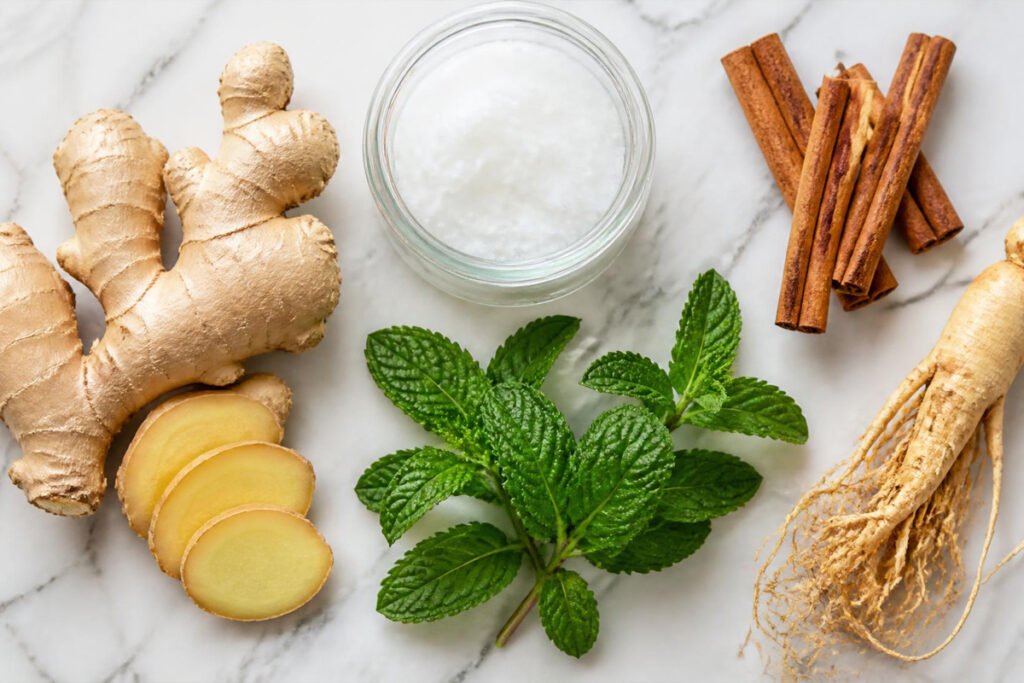
The 5 Best Foods for Brain Fog and Mental Clarity {#best-foods}
1. Ginger
Overview: Ginger contains gingerol, a compound with well-documented anti-inflammatory and antioxidant effects. By reducing inflammation, ginger may help address one of the root drivers behind persistent brain fog.
Key Features:
- High in gingerol, a potent anti-inflammatory compound
- May help stabilize blood sugar after meals
- Supports healthy digestion, which indirectly affects nutrient absorption for brain health
- Easy to add fresh, dried, or as tea
Best For: Fog that feels constant or low-grade rather than sudden
Pros: ✅ Strong anti-inflammatory evidence ✅ Versatile — tea, cooking, or raw ✅ Also supports digestion
Cons: ❌ Effects build gradually with regular use ❌ Can interact with blood thinners in large amounts
Our Verdict: Ginger tea in the morning is one of the simplest ways to address inflammation-driven fog, and it pairs naturally with the anti-inflammatory foods covered in our 17 Best Foods for Joint Pain and Arthritis Relief guide, which targets the same inflammatory pathway.
2. Coconut Oil
Overview: Coconut oil is rich in medium-chain triglycerides (MCTs), which the liver converts into ketones — an alternative fuel source your brain can use efficiently, especially useful when glucose metabolism itself feels sluggish.
Key Features:
- High in MCTs, converted to brain-usable ketones
- Doesn’t require insulin to be used as fuel, unlike glucose
- Contains lauric acid with antimicrobial properties
- Easy to add to coffee, cooking, or smoothies
Best For: Fog that feels tied to blood sugar swings or afternoon energy crashes
Pros: ✅ Alternative brain fuel source ✅ Fast-acting for some people ✅ Versatile in cooking
Cons: ❌ High in saturated fat — use in moderation ❌ Effects vary significantly between individuals
Our Verdict: For people whose fog consistently follows carb-heavy meals, a small amount of coconut oil (a teaspoon in coffee or on toast) offers the brain a fuel option that sidesteps the glucose rollercoaster entirely.
3. Peppermint
Overview: Peppermint’s aroma and compounds have been studied for their ability to produce quick, short-term improvements in alertness and cognitive performance, making it one of the fastest-acting options on this list.
Key Features:
- Contains menthol, linked to short-term alertness increases
- Can be used as tea, aromatherapy, or fresh leaves
- Caffeine-free alertness option
- May also ease tension-related fog from stress
Best For: A sudden fog episode where you need clarity within minutes, not hours
Pros: ✅ Fast-acting ✅ Zero caffeine or crash ✅ Multiple forms available (tea, oil, leaves)
Cons: ❌ Effects are short-lived, typically under an hour ❌ Not a long-term fog solution on its own
Our Verdict: Keep peppermint tea on hand for acute fog episodes — like right before a meeting — rather than relying on it as your only long-term strategy. For sustained caffeine-free energy instead, see our Best Natural Energy Foods Without Caffeine guide.
4. Cinnamon
Overview: Cinnamon has documented effects on blood sugar regulation, helping to slow the glucose spikes that often precede a fog episode 60-90 minutes after eating.
Key Features:
- May improve insulin sensitivity and slow blood sugar spikes
- Contains antioxidant compounds that reduce oxidative stress
- Easy to add to coffee, oatmeal, or baked goods
- No noticeable taste threshold issues in small daily amounts
Best For: Fog that reliably shows up after carb-heavy meals
Pros: ✅ Supports blood sugar stability ✅ Simple to add to daily meals ✅ Inexpensive and widely available
Cons: ❌ Effect size is modest, not dramatic ❌ Cassia cinnamon (the common grocery-store type) should be used in moderation due to coumarin content
Our Verdict: A half-teaspoon of cinnamon stirred into breakfast is a low-effort way to blunt the blood sugar spike that’s often the real cause behind “I always feel foggy an hour after breakfast.”
5. Ginseng
Overview: Ginseng has a long history of use for mental fatigue and is one of the more studied herbal options for supporting sustained mental clarity and stamina, particularly with consistent use over several weeks.
Key Features:
- Traditionally used to combat mental fatigue
- Contains ginsenosides, compounds studied for cognitive and energy support
- Available as tea, capsule, or root extract
- Effects tend to build with regular, consistent use
Best For: Chronic, low-level fog rather than sudden episodes
Pros: ✅ Well-studied for mental fatigue specifically ✅ Supports stamina, not just a quick spike ✅ Multiple accessible forms
Cons: ❌ Takes weeks of consistent use to notice full effects ❌ Can interact with certain medications — check with a doctor first
Our Verdict: Ginseng is less of a quick fix and more of a foundational addition — similar in philosophy to the cognitive-support approach in our Best Nootropic Supplements for Focus and Memory guide, but sourced from a single traditional root rather than a formulated blend.

Comparison Table {#comparison-table}
| Food | Best For | Key Compound | Speed of Effect | Best Time to Use |
|---|---|---|---|---|
| Ginger | Constant, low-grade fog | Gingerol | Gradual | Morning, as tea |
| Coconut Oil | Blood-sugar-linked fog | MCTs (ketones) | Moderate | With breakfast |
| Peppermint | Sudden fog episodes | Menthol | Fast | As needed |
| Cinnamon | Post-meal fog | Cinnamon polyphenols | Moderate | With meals |
| Ginseng | Chronic mental fatigue | Ginsenosides | Slow (weeks) | Daily, consistently |
Brain Fog Foods for Different Situations {#different-situations}
For Post-Meal “Food Coma” Fog
Cinnamon and coconut oil target the exact blood sugar swing responsible for the sluggish feeling after a heavy meal. This connects directly to the glucose stability strategies in our Best Foods for Insulin Resistance guide.
For Fog Tied to Stress or Burnout
Ginger’s anti-inflammatory effects and ginseng’s traditional use for mental fatigue both make sense here, but addressing the stress itself matters just as much — see our 15 Best Foods for Anxiety and Stress Relief guide for the root-cause side of this.
For an Immediate Fix Before a Meeting or Deadline
Peppermint tea is the fastest-acting option here, though it should be treated as a bridge rather than a long-term strategy — pair it with the sustained-energy approach in our Best Natural Energy Foods Without Caffeine guide for lasting results.

How to Build a Fog-Fighting Daily Routine {#daily-routine}
Step 1: Identify Your Fog Pattern
Spend three days simply noting when fog hits — right after meals, mid-morning, or all day. This determines which food to prioritize.
Step 2: Anchor Breakfast With Cinnamon and Coconut Oil
If your pattern is post-meal, start there. Stir cinnamon into oatmeal or coffee, and use coconut oil in cooking.
Step 3: Sip Ginger Tea Through the Morning
For constant, low-grade fog, replace one caffeinated drink with ginger tea to start addressing inflammation.
Step 4: Keep Peppermint on Hand for Emergencies
Stash peppermint tea bags or leaves for the moments you need clarity fast, rather than reaching for more caffeine.
Step 5: Commit to Ginseng for at Least 3-4 Weeks
If chronic fatigue-linked fog is your main issue, give ginseng a genuine multi-week trial rather than judging it after a few days.
Common Mistakes That Make Brain Fog Worse {#common-mistakes}
Mistake #1: Reaching for more caffeine. Extra coffee can mask fog temporarily but often worsens the underlying blood sugar swings once it wears off. The alternatives in our Best Natural Energy Foods Without Caffeine guide address the cause instead.
Mistake #2: Skipping meals to “reset.” Skipping meals often drops blood sugar further and makes fog worse, not better — consistent, balanced meals matter more than any single food.
Mistake #3: Not considering thyroid or iron issues. Persistent fog that doesn’t respond to dietary changes can be a sign of a thyroid or iron issue worth ruling out — see our Best Foods for Thyroid Health and 16 Best Iron-Rich Foods for Anemia and Fatigue guides for the warning signs.
Expert Tips {#expert-tips}
Track fog against your last meal, not just the clock. Fog that consistently appears 60-90 minutes after eating is a strong signal of blood sugar involvement, more so than fog tied to a specific hour of day.
Don’t underestimate hydration. Even mild dehydration produces symptoms nearly identical to brain fog — rule this out with a glass of water before assuming it’s a food or supplement issue.
Layer fast and slow fixes together. Use peppermint for the immediate moment while letting ginger, cinnamon, and ginseng work as your longer-term foundation — they’re not mutually exclusive.

Final Thoughts {#final-thoughts}
Best overall: Ginger, for its broad anti-inflammatory support and ease of daily use. Best for a quick fix: Peppermint, for fast, short-term clarity when you need it immediately. Best for the long game: Ginseng, for sustained mental stamina with consistent use.
Brain fog is almost always a signal, not a mystery — usually pointing to inflammation, blood sugar swings, or reduced blood flow. Ginger, coconut oil, peppermint, cinnamon, and ginseng each target a different piece of that puzzle, so start with whichever matches your specific pattern.
If sustained attention rather than fog clarity is your main goal, pair this with our 5 Best Foods to Improve Focus and Concentration guide. And if fog persists despite consistent changes, our Best Foods for Thyroid Health guide covers a common underlying cause worth ruling out.
FAQ {#faq}
How long does it take for these foods to clear brain fog? Fast-acting options like peppermint can help within minutes. Cinnamon and coconut oil tend to show effects within days if fog is blood-sugar-related. Ginger and ginseng typically need 2-4 weeks of consistent use for their full anti-inflammatory and mental-stamina benefits.
Can brain fog be a sign of something more serious? Occasionally, yes — persistent, unexplained fog can be linked to thyroid issues, anemia, poor sleep, or other conditions. If it doesn’t improve with diet and lifestyle changes, it’s worth discussing with a doctor.
Is coconut oil safe to eat every day? In moderate amounts (1-2 teaspoons), most people tolerate it well, but its saturated fat content means it shouldn’t replace all other cooking fats.
Why do I get foggy specifically after lunch? This is a classic sign of a post-meal blood sugar spike and crash, especially after carb-heavy meals — cinnamon and smaller, more balanced meals often help directly.
Can I drink ginger and peppermint tea together? Yes, they combine well and are often sold together as a blend, with no known negative interaction between them.
Does stress cause brain fog even with a perfect diet? Yes — chronic stress and poor sleep can produce fog regardless of diet quality, which is why addressing those alongside food changes matters.
Author: Adam Last Updated: September 2026