
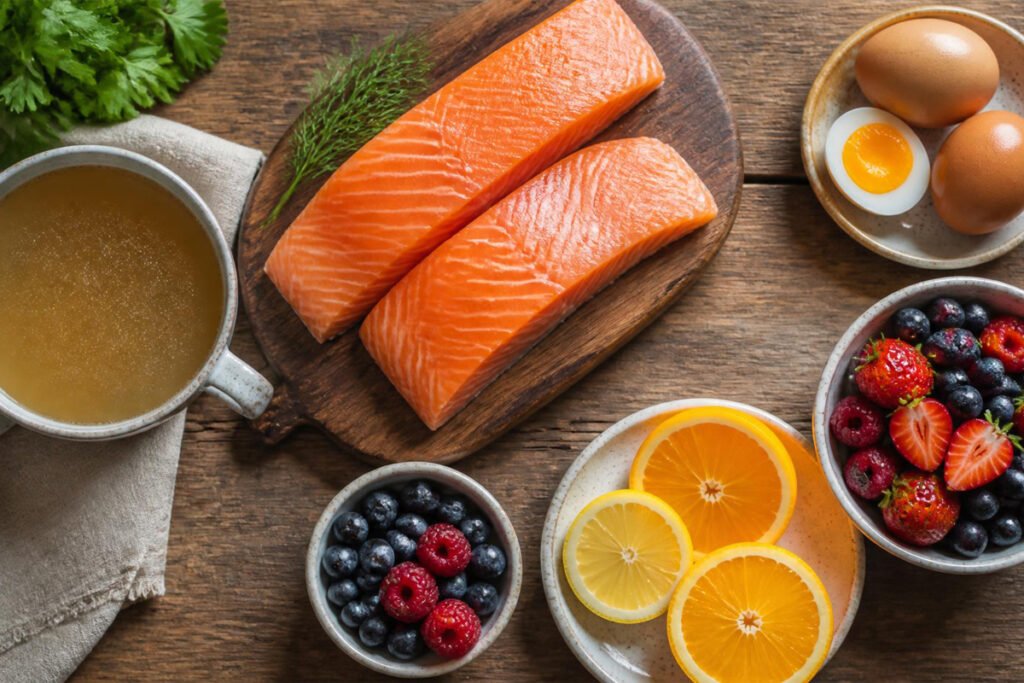
Somewhere around your late twenties, your skin starts doing something it never used to: it stops producing as much collagen as it used to. It’s gradual — a fine line here, slightly less bounce there — but by your thirties and forties, most people notice it. The supplement aisle has an answer for everything, of course, but before reaching for a collagen powder, it’s worth understanding what your body actually needs to make its own.
Collagen is the most abundant protein in your body, giving skin its structure and elasticity. You can’t eat collagen and have it go straight to your face — it gets broken down into amino acids during digestion, just like any other protein. But some foods contain the specific building blocks (and cofactor nutrients like vitamin C) your body uses to synthesize new collagen, and others contain a bioavailable, pre-broken-down form that may be easier to use directly. This guide covers both categories, so you’re not stuck choosing between bone broth and an orange when you could reasonably use both. If skin health is part of a bigger wellness push, our 30-Day Gut Health Reset Plan is worth pairing with this list, since gut and skin health are closely connected.
Quick Answer
The best collagen-rich foods fall into two categories: direct collagen sources like bone broth, chicken skin, and fish skin, which provide collagen your body can potentially use with less conversion work, and collagen-supporting foods like citrus, berries, and bell peppers, which supply the vitamin C your body requires to actually synthesize new collagen — without it, collagen production stalls regardless of how much protein you eat. For most people, the most effective approach combines both: a protein source with actual collagen content, paired with a vitamin C-rich food in the same meal.
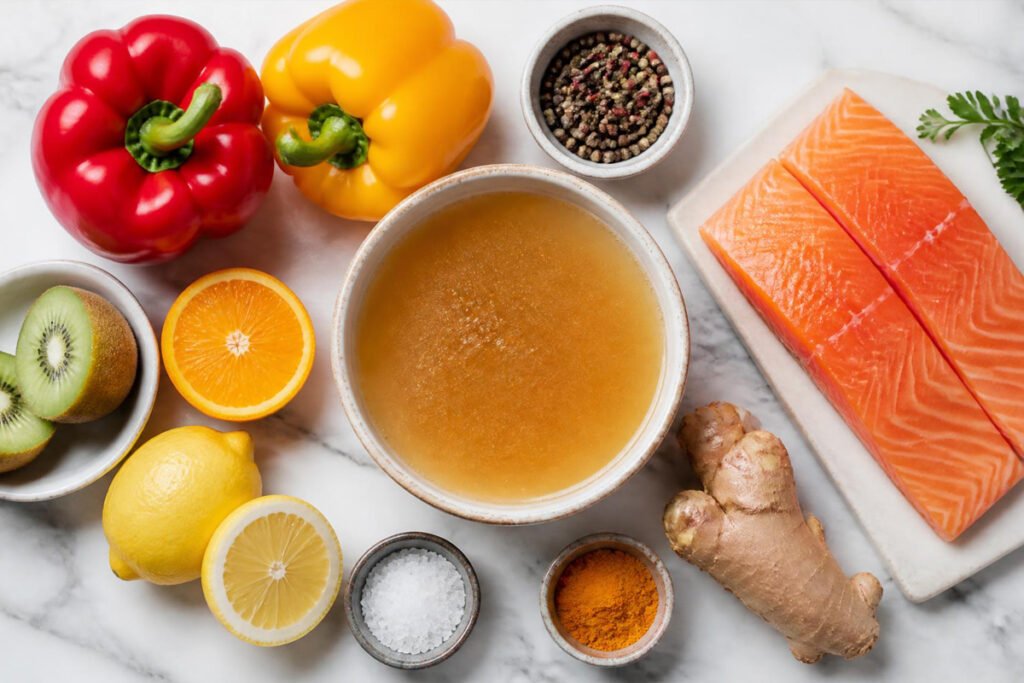
Table of Contents
- How Collagen Production Actually Works
- How to Choose the Right Foods for You
- 15 Best Collagen-Rich Foods
- Comparison Table
- Best Collagen Foods by Goal
- How to Build a Collagen-Supportive Meal
- Common Mistakes
- Expert Tips
- Final Thoughts
- FAQ
How Collagen Production Actually Works {#how-it-works}
Collagen is built from amino acids — mainly glycine, proline, and hydroxyproline — assembled into a triple-helix protein structure that gives skin, cartilage, and connective tissue their strength. Your body makes collagen on its own throughout life, but that production slows measurably with age, and accelerates further with sun exposure, smoking, and high sugar intake, all of which damage existing collagen faster than it can be replaced.
Two nutritional strategies support this process. The first is supplying the raw amino acids directly, either through actual collagen-containing foods (bone broth, skin-on poultry or fish, gelatin) or through general high-quality protein, which your body can break down into the same building blocks. The second — and often underrated — strategy is supplying the cofactors collagen synthesis depends on, especially vitamin C, along with zinc, copper, and silicon. Vitamin C in particular is not optional here: it’s a required cofactor for the enzymes that stabilize the collagen molecule, meaning that without it, collagen synthesis is measurably impaired no matter how much protein you’re eating. This is exactly why “eat this and this together” matters more for collagen than for many other nutrients. If you’re also working on skin health from an anti-inflammatory angle, our anti-inflammatory meal plan for beginners tackles a closely related mechanism, since chronic inflammation also accelerates collagen breakdown.
How to Choose the Right Foods for You {#how-to-choose}
- Are you targeting skin specifically, or joint/bone health too? Collagen supports all three, but if joints are your main concern, foods with higher glycine and proline content (bone broth, gelatin) may matter more than the vitamin C side.
- Do you eat animal products? Direct collagen sources are exclusively animal-derived. If you’re vegetarian or vegan, your strategy shifts almost entirely to supporting your body’s own production through vitamin C, zinc, copper, and adequate protein from plant sources.
- What’s realistic for you to eat regularly? Bone broth is excellent but not something most people drink daily forever — building smaller, sustainable habits (a squeeze of lemon on your salmon, berries with breakfast) often outperforms a dramatic short-term regimen.
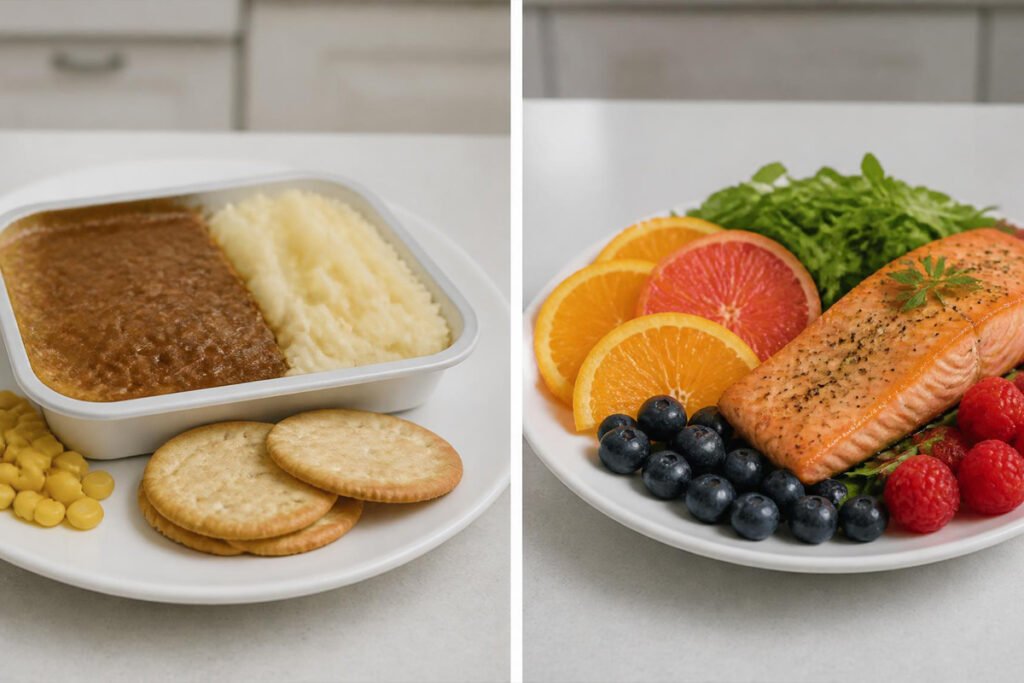
15 Best Collagen-Rich Foods {#best-foods}
1. Bone Broth
Overview: Made by simmering animal bones and connective tissue for hours, bone broth is one of the most concentrated direct sources of collagen-derived gelatin available in a typical diet. Key Features:
- Contains gelatin, the cooked form of collagen
- Rich in glycine and proline
- Versatile — sip on its own or use as a soup base Best For: Anyone wanting a direct, whole-food collagen source Pros: ✅ Most concentrated direct collagen source available without supplements ✅ Doubles as a comforting, low-calorie base for other meals Cons: ❌ Takes time to make from scratch, though store-bought versions exist ❌ Sodium content varies significantly by brand — check labels Our Verdict: A daily cup, or using it as your go-to soup and grain-cooking base, is one of the most effective habits on this list.
2. Chicken Skin
Overview: An often-discarded part of the bird that happens to be notably rich in collagen. Key Features:
- High collagen content relative to other cuts
- Crisps up well when roasted
- Widely available, no special sourcing needed Best For: People who already eat chicken regularly Pros: ✅ No extra shopping required if you already cook chicken ✅ Adds flavor and texture Cons: ❌ Also higher in saturated fat — portion and frequency matter if you’re managing cholesterol Our Verdict: Leaving the skin on occasionally, rather than trimming it every time, is a simple, low-effort swap.
3. Fish (Especially Skin-On)
Overview: Fish, particularly the skin, contains collagen, and fatty fish adds omega-3s that support skin barrier function alongside it. Key Features:
- Fish skin is notably collagen-rich
- Fatty varieties (salmon, mackerel) add omega-3s
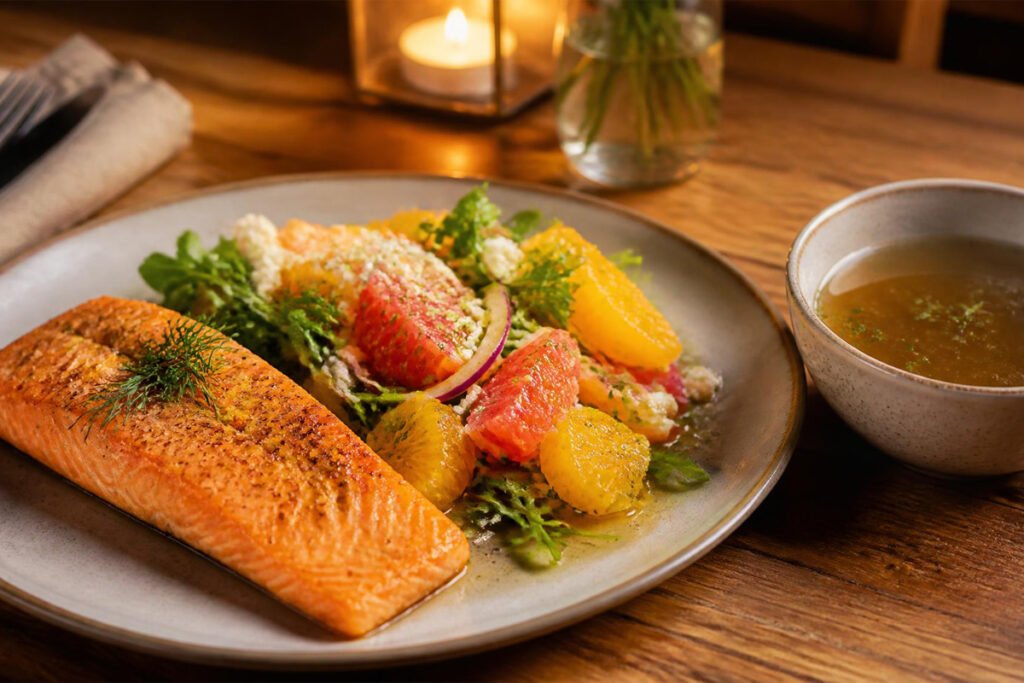
- Widely available, versatile cooking methods Best For: A twice-weekly protein swap that supports skin two ways at once Pros: ✅ Dual collagen and omega-3 benefit ✅ Crispy skin is genuinely enjoyable, not just functional Cons: ❌ Requires cooking skin-on, which not everyone is used to preparing Our Verdict: Pan-searing salmon skin-side down until crisp is an easy habit that pulls double duty for skin health.
4. Egg Whites
Overview: Rich in proline, one of the core amino acids collagen is built from. Key Features:
- High proline content
- Low calorie, high protein
- Easy to incorporate into almost any meal Best For: A daily protein habit that supports collagen’s amino acid needs Pros: ✅ Inexpensive ✅ Very versatile Cons: ❌ Egg whites alone miss some nutrients concentrated in the yolk (like the biotin and choline) Our Verdict: Whole eggs, not just whites, are a reasonable everyday collagen-supporting food — see our best breakfast foods for blood sugar control for ways to build a fuller breakfast around them.
5. Citrus Fruits (Oranges, Grapefruit, Lemons)
Overview: One of the most reliable vitamin C sources, and vitamin C is a non-negotiable cofactor for collagen synthesis. Key Features:
- High vitamin C content
- Naturally low sodium
- Easy to add to water, salads, or protein dishes Best For: Pairing with every direct collagen source on this list Pros: ✅ Directly supports the enzymatic step collagen production depends on ✅ Refreshing, versatile Cons: ❌ Grapefruit interacts with several medications — check with a pharmacist if you take prescriptions Our Verdict: The single most useful pairing food on this entire list — squeeze it over your bone broth, salmon, or eggs.
6. Bell Peppers
Overview: Often overlooked, bell peppers (especially red) actually contain more vitamin C per serving than many citrus fruits. Key Features:
- Very high vitamin C content
- Also provides vitamin A and antioxidants
- Crunchy, versatile raw or cooked Best For: A snack or side that quietly outperforms citrus for vitamin C Pros: ✅ Genuinely high vitamin C content ✅ Works in almost any savory dish Cons: ❌ Cooking reduces vitamin C content somewhat — eating some raw preserves more Our Verdict: An easy, underrated daily addition alongside your protein source.
7. Berries (Strawberries, Blueberries)
Overview: Berries combine vitamin C with anthocyanins, plant compounds studied for their antioxidant support of skin and vessel health. Key Features:
- Good vitamin C source
- Rich in antioxidants
- Lower in sugar than many fruits Best For: A daily fruit habit that supports both collagen synthesis and antioxidant protection Pros: ✅ Dual benefit — vitamin C plus antioxidant support ✅ Freezer-friendly, affordable frozen Cons: ❌ Fresh berries can be pricier out of season Our Verdict: A half-cup to a cup daily is an easy habit that supports the same skin goals from two angles at once.
8. Garlic
Overview: Contains sulfur, a mineral involved in collagen synthesis and cross-linking, alongside taurine and lipoic acid, which are studied for supporting damaged or aging collagen fibers. Key Features:
- Provides sulfur compounds relevant to collagen structure
- Adds flavor without sodium
- Easy to use daily in cooking Best For: Replacing salt as a flavor source while quietly supporting collagen Pros: ✅ Zero sodium, zero calories in typical amounts ✅ Works in almost any savory dish Cons: ❌ Effect size from culinary amounts (versus concentrated supplements) is more modest Our Verdict: A low-effort daily addition with no real downside.
9. Cashews
Overview: A good source of both zinc and copper, two minerals involved in collagen production and stabilization. Key Features:
- Provides zinc and copper
- Portable, shelf-stable snack
- Contains healthy fats Best For: A daily nut-based snack Pros: ✅ Convenient ✅ Two collagen-relevant minerals in one food Cons: ❌ Calorie-dense, so portion matters if you’re also managing weight Our Verdict: A small daily handful is a reasonable way to cover zinc and copper needs.
10. Oysters
Overview: One of the richest natural sources of zinc, a mineral required for collagen synthesis and skin repair. Key Features:
- Extremely high zinc content
- Also provides some copper and protein
- Nutrient-dense in a small serving Best For: An occasional zinc-focused meal Pros: ✅ Highly concentrated zinc source Cons: ❌ Less accessible or affordable than other zinc sources for regular use Our Verdict: A great occasional choice; cashews and pumpkin seeds are more everyday alternatives.
11. Tomatoes
Overview: Rich in lycopene, an antioxidant studied for helping protect skin from UV-related collagen breakdown, alongside a solid dose of vitamin C. Key Features:
- Good vitamin C and lycopene content
- Lycopene is more bioavailable when tomatoes are cooked
- Versatile across cuisines Best For: A base for sauces that support skin health while you cook Pros: ✅ Dual antioxidant and vitamin C benefit ✅ Versatile Cons: ❌ Canned tomato products and jarred sauces are frequently high in sodium — choose “no salt added” versions Our Verdict: Cooked tomato dishes a few times a week support collagen from the UV-protection angle specifically.
12. Soy Products (Edamame, Tofu)
Overview: Contain genistein, a plant compound studied for potentially slowing collagen breakdown, alongside complete plant protein. Key Features:
- Complete plant protein
- Contains genistein
- Versatile, absorbs flavor well Best For: Plant-based eaters building collagen-supportive protein intake Pros: ✅ Complete protein for those avoiding animal collagen sources ✅ Very versatile in cooking Cons: ❌ Doesn’t provide direct collagen — this is a supporting, not a direct, source Our Verdict: A strong staple for vegetarian and vegan eaters focused on collagen support.
13. Leafy Greens (Spinach, Kale)
Overview: A source of vitamin A and lutein, alongside modest vitamin C, that supports overall skin health alongside collagen-specific nutrients. Key Features:
- Provides vitamin A, lutein, and some vitamin C
- Low calorie, nutrient-dense
- Versatile, raw or cooked Best For: A daily vegetable base Pros: ✅ Broad nutrient support beyond just collagen ✅ Easy to add to almost any meal Cons: ❌ Lower vitamin C content than citrus or peppers — a supporting player, not a primary vitamin C source Our Verdict: A good everyday addition; see our 7 foods that protect brain cells from damage for more on why leafy greens earn a daily spot regardless.
14. Avocados
Overview: Provide vitamin E and healthy fats that support the skin’s barrier function alongside collagen-relevant nutrients. Key Features:
- Good source of vitamin E and healthy monounsaturated fat
- Naturally low sodium
- Filling, versatile Best For: Replacing less nutrient-dense fats in your diet Pros: ✅ Supports skin barrier function alongside collagen synthesis ✅ Versatile across meals Cons: ❌ Calorie-dense, so portion matters if you’re also managing weight Our Verdict: Half an avocado a few times a week rounds out a collagen-supportive diet well.
15. Dark Chocolate (in moderation)
Overview: Cocoa flavanols have been studied for supporting skin hydration and density over time, alongside a modest amount of copper. Key Features:
- Look for 70%+ cocoa content
- Contains flavanols and copper
- Small servings go a long way Best For: A treat that still supports the goal Pros: ✅ Satisfies a sweet craving without working against your skin goals Cons: ❌ Easy to overeat ❌ Milk chocolate and candy bars don’t count Our Verdict: A square or two a few times a week fits reasonably into a collagen-supportive pattern.
Comparison Table {#comparison-table}
| Food | Best For | Role | Key Nutrient | Ease of Daily Use |
|---|---|---|---|---|
| Bone Broth | Direct collagen source | Direct | Gelatin (glycine, proline) | Medium |
| Fish (skin-on) | Dual skin benefit | Direct | Collagen + omega-3s | Medium |
| Citrus | Synthesis booster | Supporting | Vitamin C | High |
| Bell Peppers | Underrated vitamin C | Supporting | Vitamin C | High |
| Berries | Antioxidant + vitamin C | Supporting | Vitamin C, anthocyanins | High |
| Cashews | Daily mineral snack | Supporting | Zinc, copper | High |
| Soy Products | Plant-based protein | Supporting | Protein, genistein | High |
Best Collagen Foods by Goal {#by-goal}
If You’re Focused on Skin Firmness Specifically
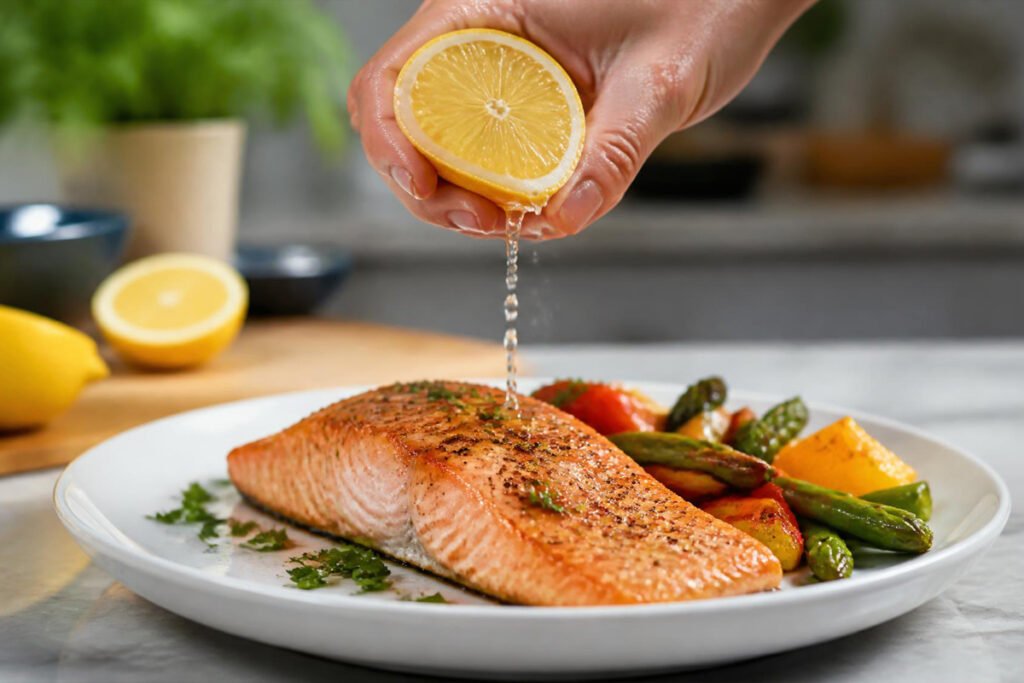
Prioritize the vitamin C pairing principle above all else — citrus, bell peppers, and berries alongside any protein source. Without adequate vitamin C, even a diet full of collagen-rich foods won’t synthesize new collagen efficiently.
If You’re Vegetarian or Vegan
Direct collagen sources aren’t an option, so lean entirely on supporting your body’s own production: soy products and beans for protein, citrus and peppers for vitamin C, and cashews or pumpkin seeds for zinc and copper. Our Mediterranean diet meal plan for beginners leans plant-forward and overlaps well with this approach.
If Joint Health Matters as Much as Skin
Bone broth and gelatin are more directly relevant here than the vitamin C side, since glycine and proline content matters more for cartilage support specifically. Consistency over months tends to matter more than any single high dose.
How to Build a Collagen-Supportive Meal {#how-to-build}
Step 1: Choose a Protein Base
Bone broth, skin-on fish, chicken, eggs, or a plant-based protein like tofu.
Step 2: Add a Vitamin C Food in the Same Meal
Citrus, bell peppers, or berries — eaten alongside, not hours apart, since vitamin C’s role is most useful when synthesis-relevant amino acids are also present.
Step 3: Include a Zinc or Copper Source
Cashews, pumpkin seeds, or oysters a few times a week round out the mineral side of collagen synthesis.
Step 4: Limit What Breaks Collagen Down Faster Than You Can Replace It
High sugar intake and excess sun exposure both accelerate collagen breakdown — this is as much a “what to limit” strategy as a “what to add” one.
Step 5: Be Consistent, Not Dramatic
Collagen turnover happens over weeks and months, not days — a sustainable daily pattern outperforms a short, intense supplement regimen you abandon after two weeks.
Common Mistakes {#common-mistakes}
- Eating collagen-rich foods without any vitamin C. Without it, your body’s ability to actually synthesize and stabilize new collagen is measurably impaired — the pairing isn’t optional, it’s the mechanism.
- Expecting visible changes within days. Skin cell and collagen turnover happens over weeks to months — realistic expectations matter as much as food choice.
- Ignoring what accelerates collagen breakdown. Sun protection and limiting added sugar do as much for visible skin firmness as any food on this list — diet alone can’t outpace consistent UV damage.
Expert Tips {#expert-tips}
- Pair, don’t separate. Squeeze lemon over your salmon, add bell pepper to your bone broth soup, or eat berries alongside your morning eggs — the pairing habit matters more than eating each food in isolation.
- Don’t skip sun protection. No food or supplement fully offsets UV-driven collagen breakdown — sunscreen is doing more heavy lifting here than most people assume.
- Consider your protein intake overall, not just “collagen foods.” Adequate total protein gives your body the broader amino acid pool it needs, beyond just the foods specifically labeled “collagen-rich.”
Final Thoughts {#final-thoughts}
Best overall: Bone broth paired with citrus, combining a direct collagen source with the vitamin C your body needs to actually use it. Best for plant-based eaters: Soy products and bell peppers together, covering protein and vitamin C without any animal source. Best for beginners: Simply adding citrus to meals you already eat — the lowest-effort, highest-relevance habit on this entire list.
Collagen support isn’t about one miracle food — it’s a pairing strategy sustained over months, alongside the basics (sun protection, limiting added sugar) that protect the collagen you already have. If you’re building a broader skin- and gut-health routine, our 30-Day Gut Health Reset Plan and anti-inflammatory meal plan for beginners both complement this list well.
Frequently Asked Questions {#faq}
Do collagen supplements work better than food? Research is still developing on this. Bone broth and food-based collagen provide the same broken-down amino acids that supplements do, and since supplements aren’t FDA-regulated for efficacy claims, a food-first approach is a reasonable, lower-risk starting point.
Can I eat collagen and have it go straight to my skin? Not directly — collagen you eat is broken down into amino acids during digestion, just like any other protein, and your body decides where to use those amino acids. Food supports the building blocks, not a guaranteed direct delivery to your face.
What’s the single most important food on this list? If you had to pick one, vitamin C-rich foods (citrus, bell peppers, berries) are arguably more important than direct collagen sources, since collagen synthesis is impaired without adequate vitamin C, regardless of protein intake.
Does drinking bone broth every day actually make a difference? Consistent, regular intake over weeks to months is where most reported benefits come from — an occasional cup is pleasant but unlikely to move the needle much on its own.
Can vegans get enough collagen-supportive nutrients from food? Yes, though the strategy shifts entirely to supporting your body’s own production — vitamin C, zinc, copper, and adequate plant protein — since direct collagen sources are exclusively animal-derived.
Does sugar really affect collagen that much? Yes. Excess sugar intake contributes to a process called glycation, which can damage existing collagen fibers and make them less elastic over time — this is one of the more well-supported “what to limit” pieces of skin-health advice.
How long before I’d notice a difference in my skin? Skin cell turnover and collagen remodeling happen over weeks to months, not days. Most people evaluating a new habit should give it at least 8-12 weeks of consistency before judging results.
Is chicken skin actually good for me, or just tasty? Both — it’s genuinely collagen-rich, though it’s also higher in saturated fat, so moderation and frequency matter, especially if you’re also managing cholesterol.
Do I need a vitamin C supplement, or is food enough? For most people without a diagnosed deficiency, consistent food sources (citrus, peppers, berries) provide enough vitamin C to support collagen synthesis without needing a supplement.
What role does sleep play in collagen production? Your body does much of its tissue repair, including collagen synthesis, during deep sleep — consistently poor sleep can undercut even a well-planned diet’s benefits for skin health.
Author: Howdy, AdamLast Updated: August 2026