
Walk down any supplement aisle and you’ll see the same thing: dozens of bottles all shouting “50 billion CFU!” or “15 strains!” — with almost no way to tell which one is actually worth taking. If you’ve started a gut-health push (maybe after trying our 30-Day Gut Health Reset Plan) and you’re wondering whether a probiotic supplement belongs in that plan, you’re not alone.
The honest answer is: it depends on the strain, not the sticker on the bottle. A generic blend and a specific, clinically studied strain can produce completely different results, even at the same CFU count. This guide breaks down real, widely available probiotic supplements — what they actually contain, who they tend to help, and what to watch out for — so you can make an informed choice rather than guessing based on packaging.
Quick Answer
If you want the single most-studied option, Culturelle Digestive Daily uses Lactobacillus rhamnosus GG, a strain backed by over 1,000 published studies. If you want broad strain diversity and third-party testing, Seed DS-01 Daily Synbiotic is the most researched multi-strain option, though it’s also the priciest. For IBS-specific bloating, Align is the strain gastroenterologists reference most often. If you’re on antibiotics, Florastor (a yeast-based probiotic) is unique in that antibiotics don’t kill it. And if budget matters most, NOW Foods Probiotic-10 delivers a solid multi-strain formula at one of the lowest costs per month.
Table of Contents
- How Probiotics Actually Work
- How to Choose the Right Probiotic for You
- 7 Best Probiotic Supplements
- Comparison Table
- Best Probiotics for Different Needs
- How to Start Taking a Probiotic
- Common Mistakes
- Expert Tips
- Final Thoughts
- FAQ
How Probiotics Actually Work {#how-they-work}
Probiotics are live microorganisms that, in adequate amounts, may support digestive and immune health. The key phrase is “in adequate amounts” — many probiotics die off before they ever reach your gut, whether from stomach acid, poor manufacturing, or being stored too long on a warm shelf.
The research consensus, based on the widely cited Hill et al. definition of probiotics, is that health benefits are strain-specific, not species-specific. In plain terms: a label that just says “Lactobacillus acidophilus” tells you far less than one that lists the full strain code (like “Lactobacillus rhamnosus GG”), because clinical evidence is tied to that exact strain, not the species as a whole. This is why two products with the same CFU count can perform very differently — one might use a well-studied strain at a modest dose, while the other uses an unstudied blend at a flashy, high dose.
If you’re also working on your broader diet, our anti-inflammatory meal plan for beginners and best foods for insulin resistance guides cover food-based ways to support the same gut and metabolic systems probiotics target.
How to Choose the Right Probiotic for You {#how-to-choose}
- What’s your actual goal? General digestive maintenance, IBS-specific bloating, and antibiotic recovery each point toward different strains — there’s no single “best” probiotic for everyone.
- Do you need refrigeration or shelf stability? Some products require the fridge to stay viable; others use delayed-release capsules that don’t. If you travel often, shelf-stable matters more than it sounds.
- Is it third-party tested? Supplements aren’t FDA-approved before sale the way medications are, so independent testing (NSF, USP, or similar) is one of the few ways to verify a label’s claims are accurate.
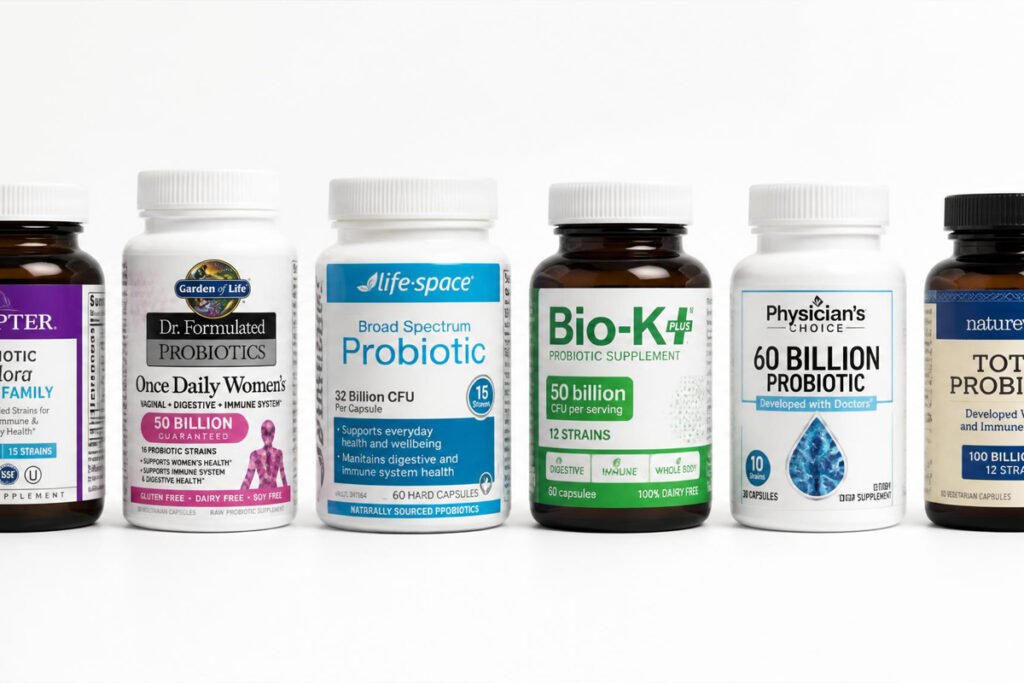
7 Best Probiotic Supplements for Gut Health {#best-probiotics}
1. Seed DS-01 Daily Synbiotic
Overview: The most clinically researched multi-strain option on the market, combining 24 studied strains with a prebiotic component, making it a synbiotic rather than a standalone probiotic. Key Features:
- 24 clinically studied strains, ~53.6 billion AFU (a more precise measure than standard CFU)
- Includes a prebiotic to help feed the probiotic strains
- Shelf-stable, no refrigeration needed
- Third-party tested Best For: People who want the broadest strain diversity and don’t mind a premium price Pros: ✅ Most extensively researched multi-strain formula available ✅ No refrigeration needed ✅ Published trials on the actual formulation, not just individual strains Cons: ❌ Among the most expensive options on this list ❌ Subscription-based purchasing model Our Verdict: If budget isn’t the deciding factor and you want the most evidence behind a multi-strain formula, this is the standout pick.
2. Culturelle Digestive Daily
Overview: A single-strain probiotic built around Lactobacillus rhamnosus GG (LGG), the single most-studied probiotic strain in the world. Key Features:
- 10 billion CFU of Lactobacillus rhamnosus GG per capsule
- Includes the prebiotic inulin
- CFU count guaranteed through the expiration date, not just at manufacture Best For: Anyone who wants a simple, well-evidenced starting point Pros: ✅ Backed by over 1,000 published studies on this exact strain ✅ Affordable relative to research depth ✅ Widely available Cons: ❌ Not routinely third-party tested for purity, though the company states it takes internal quality measures Our Verdict: The safest first probiotic to try if you’re new to supplementing and want strong evidence without a high price tag.
3. Align Extra Strength
Overview: Built around Bifidobacterium 35624, the strain gastroenterologists most often reference for IBS-related bloating and discomfort. Key Features:
- Contains Bifidobacterium 35624 at a clinically studied dose
- Effective at a comparatively low CFU count, since dose matters less than strain match for this one
- Once-daily capsule Best For: People managing IBS symptoms specifically, rather than general maintenance Pros: ✅ Strongest strain-specific evidence for bloating and IBS symptoms ✅ Simple once-daily dosing Cons: ❌ Narrower use case than multi-strain products — less useful if IBS isn’t your concern Our Verdict: The most targeted pick on this list if bloating or IBS symptoms are your main issue.
4. Florastor
Overview: A yeast-based probiotic (Saccharomyces boulardii) rather than a bacterial one — notable because antibiotics don’t kill it, unlike most bacterial probiotics. Key Features:
- Uses Saccharomyces boulardii lyo, a probiotic yeast
- Can be taken during a course of antibiotics without being wiped out
- Shelf-stable Best For: Anyone taking antibiotics who wants to support gut flora during the course Pros: ✅ Unique antibiotic-compatible mechanism ✅ Well-studied for antibiotic-associated digestive upset Cons: ❌ More niche use case — not typically the first choice for general daily maintenance Our Verdict: Keep this one in mind specifically for antibiotic courses rather than as an everyday probiotic.
5. NOW Foods Probiotic-10
Overview: A straightforward, budget-friendly multi-strain formula from a long-established supplement manufacturer. Key Features:
- 25 billion CFU from 10 strains
- GMP-certified manufacturing, regularly submitted for third-party verification
- No added prebiotic, keeping the formula simple Best For: Budget-conscious buyers who still want a credible multi-strain option Pros: ✅ One of the lowest costs per month on this list ✅ CFU count sits in the range dietitians commonly recommend for everyday maintenance Cons: ❌ No prebiotic included, unlike synbiotic options ❌ Less strain-specific research than single-strain products like Culturelle or Align Our Verdict: A sensible default if you want multi-strain coverage without a subscription price tag.
6. Garden of Life Dr. Formulated Probiotics
Overview: A food-based, high-strain-count line with versions formulated for general gut health, men, and women. Key Features:
- ~50 billion CFU across 16 strains (Once Daily formula)
- Non-GMO Project verified and third-party certified
- Multiple formula variants for different needs Best For: People who prefer food-based, third-party-certified supplement lines Pros: ✅ High strain diversity with independent certification ✅ Formula options tailored to different needs Cons: ❌ Higher strain count doesn’t always mean stronger evidence than a targeted single-strain product Our Verdict: A solid choice if third-party certification and formula variety matter more to you than picking one hyper-specific strain.
7. Physician’s Choice 60 Billion Probiotic
Overview: A high-CFU, 10-strain formula positioned as a value option in the crowded probiotic market. Key Features:
- 60 billion CFU from 10 strains
- Includes organic prebiotic fiber in some formulations
- Widely available and competitively priced Best For: People who want a high CFU count at a moderate price Pros: ✅ Strong CFU-per-dollar value ✅ Multi-strain coverage Cons: ❌ As with most high-CFU blends, more isn’t automatically better — strain-specific evidence still matters more than the headline number Our Verdict: A reasonable mid-range pick if you want a high CFU count without paying premium prices.
Comparison Table {#comparison-table}
| Product | Best For | Strain Highlight | CFU / AFU | Refrigeration |
|---|---|---|---|---|
| Seed DS-01 | Broadest research | 24-strain synbiotic | ~53.6 billion AFU | Not required |
| Culturelle Digestive Daily | Simple, proven start | L. rhamnosus GG | 10 billion CFU | Not required |
| Align Extra Strength | IBS / bloating | Bifidobacterium 35624 | Lower dose, strain-specific | Not required |
| Florastor | During antibiotics | Saccharomyces boulardii (yeast) | Varies by product | Not required |
| NOW Foods Probiotic-10 | Budget multi-strain | 10-strain blend | 25 billion CFU | Not required |
| Garden of Life Dr. Formulated | Certified, food-based | 16-strain blend | ~50 billion CFU | Check product |
| Physician’s Choice 60 Billion | High CFU value | 10-strain blend | 60 billion CFU | Not required |
Best Probiotics for Different Needs {#by-need}
If You’re New to Probiotics
Start with a well-studied single strain like Culturelle rather than jumping straight to the highest CFU count you can find. It’s easier to tell if a targeted strain is working for you, and the evidence behind it is clearer.
If You Have IBS or Frequent Bloating
Align’s Bifidobacterium 35624 has the most direct clinical support for this specific symptom pattern. Pairing it with the food-based strategies in our 30-Day Gut Health Reset Plan tends to work better than either approach alone.
If You’re Currently on Antibiotics
Florastor’s yeast-based mechanism means it survives antibiotics that would wipe out bacterial probiotics — worth discussing with your doctor if you’re prone to antibiotic-related digestive upset.
If Cost Is Your Main Constraint
NOW Foods Probiotic-10 offers credible multi-strain coverage without a subscription commitment, and pairs well with the fiber-rich foods in our 25 high-protein foods that keep you full longer guide for a fuller gut-health approach.
How to Start Taking a Probiotic {#how-to-start}
Step 1: Identify Your Goal
General maintenance, IBS symptoms, or antibiotic support each point to a different strain — decide this before you shop.
Step 2: Check the Label for Strain, Not Just CFU
Look for the full strain designation (letters and numbers after the species name), not just a big CFU number.
Step 3: Start With One Product for 4–6 Weeks
Gut microbiome changes are gradual. Switching products every week makes it impossible to tell what’s actually working.
Step 4: Track How You Feel
Note digestion, bloating, and regularity in a simple log rather than relying on memory alone.
Step 5: Reassess and Adjust
If nothing changes after 4–8 weeks, it’s reasonable to try a different strain — or to conclude you may not need a supplement at all, especially if your diet already includes fermented foods.
Common Mistakes {#common-mistakes}
- Choosing based on CFU count alone. A well-studied strain at 10 billion CFU can outperform an unstudied blend at 100 billion. Strain evidence matters more than the headline number.
- Expecting overnight results. Most probiotic research measures outcomes over weeks, not days — pair realistic expectations with the steady, whole-food approach in our Mediterranean diet meal plan for beginners.
- Skipping the “why” before buying. Buying a random top-rated bottle without a specific goal makes it hard to know if it’s working — match the product to your actual symptom or goal first.
Expert Tips {#expert-tips}
- Fermented foods can complement, not just replace, a supplement. Yogurt, kefir, kimchi, and sauerkraut deliver live cultures alongside real nutrients that capsules don’t provide.
- Talk to a doctor first if you’re immunocompromised, pregnant, or managing a chronic illness. Probiotics are generally well tolerated, but these groups warrant a conversation before starting one.
- Store products as directed. Even shelf-stable options can lose potency in a hot car or a steamy bathroom cabinet — a cool, dry spot protects your investment.

Final Thoughts {#final-thoughts}
Best overall: Seed DS-01, for the depth of research behind its full formula. Best budget pick: NOW Foods Probiotic-10, for solid multi-strain coverage at a low monthly cost. Best for beginners: Culturelle Digestive Daily — a single, extensively studied strain that’s easy to evaluate.
Whichever you choose, a probiotic works best as one part of a broader gut-health approach, not a standalone fix. Pair it with the food-based habits in our 30-Day Gut Health Reset Plan and anti-inflammatory meal plan for beginners for a more complete strategy.
Frequently Asked Questions {#faq}
Do I actually need a probiotic supplement, or can food alone do the job? If you already eat a varied, fiber-rich diet with fermented foods like yogurt or kefir, you may not need a capsule at all. Supplements are most useful when targeting a specific issue — like IBS symptoms or antibiotic recovery — rather than as a blanket wellness habit.
How long before I notice a difference? Most guidance suggests giving a probiotic 4 to 8 weeks of consistent use before judging whether it’s working. Skipping doses resets the process, since gut microbiome shifts are gradual.
Is a higher CFU count always better? No. The specific strain matters more than the raw CFU number — a well-studied strain at a modest dose often outperforms an unstudied high-CFU blend.
What’s the difference between a probiotic and a synbiotic? A probiotic contains live beneficial organisms. A synbiotic combines probiotics with prebiotics (fiber that feeds those organisms), which some research suggests may improve how well the strains survive and colonize.
Can I take a probiotic while on antibiotics? Most bacterial probiotics are reduced in effectiveness by antibiotics taken at the same time, which is why yeast-based options like Florastor (unaffected by antibiotics) are often recommended specifically for this situation. Space bacterial probiotics a few hours apart from antibiotic doses, and check with your doctor or pharmacist for personalized guidance.
Do probiotics need to be refrigerated? It depends on the product. Many modern formulas use delayed-release capsules or freeze-dried strains that are shelf-stable, but always check the specific product’s storage instructions.
Are probiotics safe for everyone? Probiotics are generally well tolerated, but people who are immunocompromised, pregnant, or managing a chronic illness should talk to a doctor before starting one, since live organisms carry a small infection risk in those groups.
What does “third-party tested” actually mean? It means an independent lab (not the manufacturer) verified that the product contains what the label claims, at the stated potency. Since supplements aren’t pre-approved by the FDA the way medications are, this is one of the few external checks available to consumers.
Author: Howdy, Adam Last Updated: August 2026