

Six foods quietly dismantling your focus every day — and the science-backed plan to take your mental clarity back.
Brain fog — that maddening combination of mental cloudiness, slow thinking, forgetfulness, and inability to concentrate — affects millions of people who assume it’s just stress, age, or “how they are.” But a growing body of research points to a much more actionable cause: what we eat, meal after meal, is quietly sabotaging our cognition.
This article walks through the six biggest dietary drivers of brain fog, the mechanisms behind each, and — most importantly — exactly what to do instead.
·
People Also Ask
Can food really cause brain fog?
How long does it take for diet changes to clear brain fog?
What foods clear brain fog fast?
Is brain fog a sign of something serious?
The 6 Foods Most Likely Causing Your Brain Fog

Culprit No. 1
Refined Sugar & High-Glycemic Carbohydrates
The brain needs steady glucose — not a rollercoaster. When you eat white bread, pastries, sweetened drinks, or white rice, blood sugar spikes sharply, triggering a rapid insulin response that crashes it back down. That crash is the “afternoon slump” you know too well: sudden fatigue, poor concentration, irritability.
Over years, chronically elevated insulin impairs the brain’s own insulin signalling. Some researchers now refer to late-stage cognitive decline driven by this mechanism as “Type 3 diabetes” — a concept explored in Alzheimer’s research at institutions including Brown University and the National Institute on Aging.
The fix isn’t to fear carbohydrates. It’s to choose slow ones — whole grains, legumes, vegetables — and always pair them with protein and healthy fat to blunt the glucose response.
Action: Replace one high-glycemic item per day this week. Fruit juice → whole fruit. White rice → brown or cauliflower rice. Soda → sparkling water with lemon.
Culprit No. 2
Industrial Seed Oils
Soybean oil. Corn oil. Sunflower oil. Cottonseed oil. They’re in almost everything processed — and they’re flooding your body with omega-6 fatty acids at a ratio wildly out of sync with human evolution.
Our ancestral omega-6 to omega-3 ratio is estimated at roughly 1:1 to 4:1. Modern Western diets deliver 15–20:1. This imbalance promotes systemic inflammation — including in the brain — which impairs neurotransmitter function, reduces neuroplasticity, and is strongly associated with depression and cognitive difficulty in epidemiological research.
Action: Cook with extra virgin olive oil, avocado oil, coconut oil, or grass-fed butter. Read ingredient labels — seed oils hide in almost all packaged sauces, dressings, crackers, and snacks.
“The brain is approximately 60% fat by dry weight. What kind of fat you eat determines, quite literally, what your brain is made of.”— Nutritional Neuroscience Research
Culprit No. 3
Alcohol
This one is rarely discussed with honest directness: alcohol is a neurotoxin. Even at socially accepted consumption levels, regular drinking is associated with measurable reductions in brain volume — particularly in the hippocampus, the structure responsible for memory formation.
Alcohol also devastates sleep architecture, suppressing the deep restorative sleep stages where the brain clears metabolic waste via the glymphatic system. You may fall asleep faster, but you wake up more cognitively impaired — and over time, this becomes invisible, mistaken for simply how your brain works.
A 30-day alcohol-free period is one of the highest-leverage cognitive experiments you can run. Most people are startled by how much clearer they feel.
Action: Commit to one alcohol-free week and note changes in morning clarity, word recall, and mood. Track it in a simple journal.
Culprit No. 4
Ultra-Processed Foods
Defined by the NOVA classification system, ultra-processed foods are industrial formulations — not so much “made from food” as “made from substances extracted from food.” Think flavored chips, packaged pastries, instant noodles, fast-food meals, processed meats with lengthy ingredient lists.

Large epidemiological studies — including a 2022 study in JAMA Neurology tracking over 72,000 participants — found that higher ultra-processed food consumption was significantly associated with accelerated cognitive decline, even after adjusting for other lifestyle factors.
The mechanisms are multiple: gut microbiome disruption, nutritional bankruptcy (these foods lack the B vitamins, magnesium, and zinc that the brain depends on), excessive refined carbs and seed oils, and chemical additives whose long-term neurological effects remain understudied.
Action: Apply the “kitchen test”: could you make this in your own kitchen from recognizable ingredients? If not, it’s almost certainly ultra-processed. Aim to cook from whole ingredients at least five meals per week.
Culprit No. 5
Artificial Trans Fats
Though partially hydrogenated oils have been banned or restricted in many countries, trans fats still appear in some commercial baked goods, imported products, and fast food. They are uniquely damaging: they impair memory, increase neuroinflammation, and reduce brain-derived neurotrophic factor (BDNF) — a protein critical for learning and memory formation.
Check ingredient labels specifically for the words “partially hydrogenated”. Even products labeled “0g trans fat” may contain up to 0.5g per serving — which adds up quickly across multiple servings.
Action: Audit your pantry this week. Any product listing “partially hydrogenated oil” goes in the bin — no exceptions.
Culprit No. 6
Artificial Sweeteners (in high amounts)
The science here is more nuanced and less settled — but the signals are worth heeding. Some research, including studies published in Nature, suggests that certain artificial sweeteners (particularly saccharin and sucralose) alter gut microbiome composition in ways that impair glucose metabolism. Aspartame breaks down into phenylalanine and methanol, which at high intakes may affect neurotransmitter levels.
The honest position: evidence is not yet conclusive, and individual responses vary. But if mental clarity is the goal, there’s little reason to maintain a high intake of any sweetener — artificial or otherwise.
Action: Gradually reduce sweetness exposure across all sources. This recalibrates your palate within 3–4 weeks, making whole foods taste more satisfying and rich.
· · ·
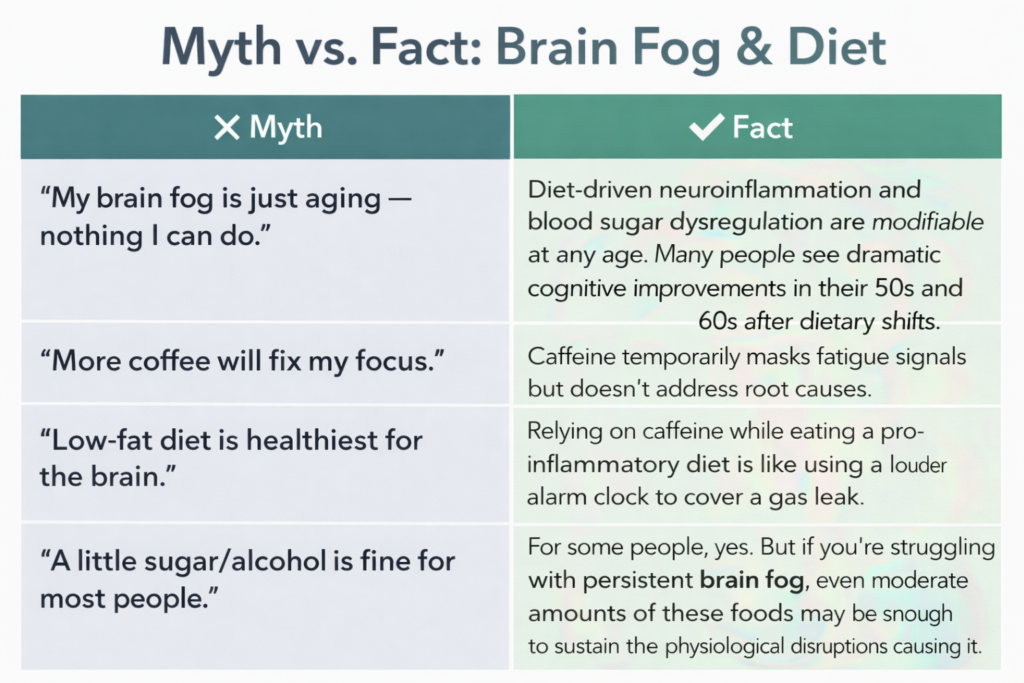
Myth vs. Fact: Brain Fog & Diet
Your 30-Day Brain Fog Elimination Plan
The most effective way to identify your personal brain fog triggers is structured elimination. Here’s how:
- Week 1 — Clear the DecksRemove all refined sugar, industrial seed oils, alcohol, and ultra-processed foods simultaneously. Stock whole foods: eggs, fish, meat, vegetables, legumes, whole grains, olive oil, nuts.
- Week 2 — Observe & RecordKeep a simple daily log (1–10 scale) of mental clarity, energy, mood, and focus. Most people notice changes between days 5–10. Sleep quality typically improves noticeably around days 7–12.
- Week 3 — StabilizeBuild new habits around your baseline. Meal prep to reduce decision fatigue. Find two or three satisfying go-to meals that fit the new template. The goal is friction reduction, not perfection.
- Week 4 — Reintroduce One at a TimeAdd back one eliminated food group for 48 hours. Note any changes in cognition, mood, or sleep within 24–72 hours. Wait 3 days before introducing the next. This is how you discover your individual sensitivities.
- Beyond Day 30 — Maintain What WorksYou’ll have real data from your own body — not generic advice. Build your long-term eating pattern around what genuinely makes you think and feel better.
Start Here. Start Today.
You don’t need to overhaul your entire life before breakfast. Start with the highest-leverage swap you can make this week.
- Replace one sugary drink with water or herbal tea
- Cook one meal with olive oil instead of seed oil
- Take one alcohol-free day and log how you feel
- Check one packaged food for “partially hydrogenated”
- Cook one meal from whole, recognizable ingredients
Small consistent changes compound into transformation. Your brain is waiting.
Scientific Sources & Further Reading
- Neth, B.J. & Craft, S. (2017). Insulin Resistance and Alzheimer’s Disease. Neurotherapeutics. PubMed →
- Simopoulos, A.P. (2002). The importance of the ratio of omega-6/omega-3 essential fatty acids. Biomedicine & Pharmacotherapy. PubMed →
- Topiwala, A. et al. (2017). Moderate alcohol consumption as risk factor for adverse brain outcomes. BMJ. BMJ →
- Li, H. et al. (2022). Association of Ultra-processed Food Consumption With Risk of Dementia. JAMA Neurology. PubMed →
- Suez, J. et al. (2014). Artificial sweeteners induce glucose intolerance by altering the gut microbiota. Nature. Nature
Medical Disclaimer: This article is for informational purposes only and does not constitute medical advice. Brain fog can have many causes, including thyroid disorders, anemia, sleep apnea, and more. Always consult a qualified healthcare provider before making significant dietary changes or if symptoms are severe or persistent.