
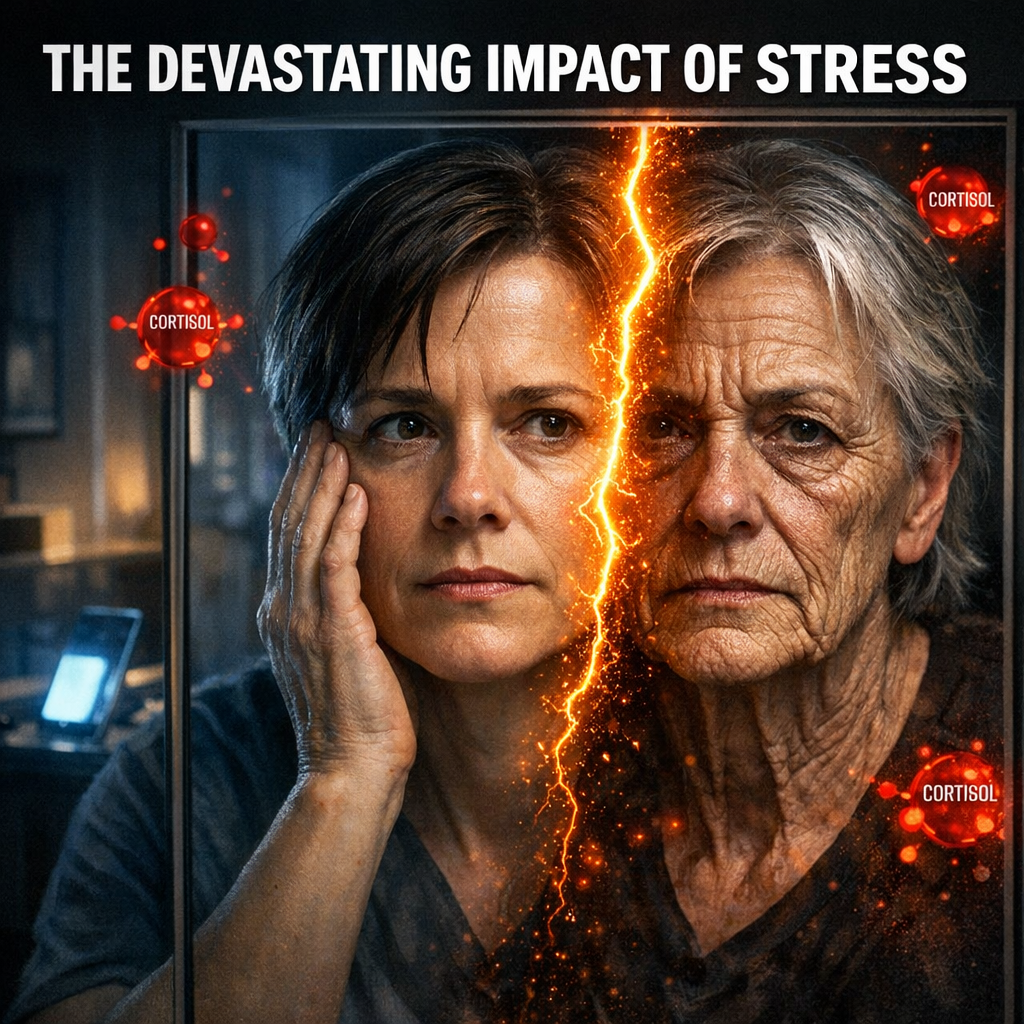
Cortisol Is Aging You Faster Than Junk Food Ever Could — Here’s How to Stop It
It’s not the burger you had on Friday. It’s not the glass of wine on a Thursday night. The thing that’s quietly accelerating your aging, shrinking your brain, storing fat around your waist, and dismantling your health from the inside out — is invisible. And you’re probably producing too much of it right now, as you read this.
It’s cortisol. Your body’s primary stress hormone. And chronic overexposure to it is one of the most damaging things that can happen to a human body — more destructive, in many measurable ways, than poor diet alone.
The worst part? Most people have no idea it’s happening. They feel tired but wired. They gain weight despite eating carefully. They sleep but wake up exhausted. They age faster than their years. They chalk it up to genetics, or getting older, or “just being stressed.”
It’s not just stress. It’s what chronic stress does to your biology. And once you understand the mechanism — once you can see exactly what elevated cortisol is doing to your body at the cellular level — the urgency to address it becomes impossible to ignore.
This is that understanding. And more importantly, this is what to do about it.

What Cortisol Actually Is — And Why It’s Becoming a Crisis
Cortisol is not inherently a villain. In the right doses, at the right moments, it is a lifesaver — literally. It sharpens your focus in acute danger, mobilizes energy to your muscles for fight or flight, suppresses non-essential functions so your body can deal with an immediate threat, and then — when the threat passes — it recedes and allows your system to return to normal.
That cycle — threat, response, recovery — is the way cortisol was designed to work. Short bursts of high cortisol, followed by genuine rest and return to baseline.

The problem is that modern life has broken that cycle completely.
Your nervous system cannot distinguish between a charging predator and a passive-aggressive email from your boss. It cannot tell the difference between physical danger and financial anxiety. It responds to a brutal news cycle, a difficult relationship, a looming deadline, and a traffic jam with the same biological alarm system it would activate if your life were genuinely at risk.
And unlike the ancient threats it evolved to handle — which passed — modern stressors are continuous. They never fully resolve. The inbox refills. The bills return. The news cycle never ends. The relationship tension persists.
The result is cortisol that stays elevated not for minutes but for days, months, years. And chronically elevated cortisol is a biological catastrophe unfolding in slow motion.
A 2022 study published in Nature Aging confirmed what researchers had been observing for years: high cortisol levels in adults are directly linked to faster cognitive decline, weaker immune function, and accelerated biological aging. Not metaphorical aging. Measurable, cellular, accelerated biological aging — the kind that shows up in your telomeres, your inflammatory markers, your organ function.
Translation: chronic stress doesn’t just feel terrible. It makes you biologically older, faster, in ways that no amount of clean eating fully compensates for.
What Chronically High Cortisol Does to Your Body
Before we talk solutions, you need to see the full picture of what’s happening when cortisol stays elevated long-term. Because the list is longer and more serious than most people realize.
It breaks down muscle tissue. Cortisol is catabolic — meaning it breaks down tissue for energy. In acute stress, this is useful. In chronic stress, it means your body is quietly cannibalizing the muscle you’ve worked hard to build, contributing to weakness, reduced metabolic rate, and the loss of the physical capacity you need for a high-quality life.
It stores fat — specifically around your abdomen. Visceral fat — the deep abdominal fat that wraps around your organs — is directly stimulated by cortisol. This is not cosmetic. Visceral fat is metabolically active in the worst way: it produces inflammatory compounds that further disrupt hormone balance, insulin sensitivity, and cardiovascular health.
It shrinks the hippocampus. The hippocampus is your brain’s memory and learning center. Chronic cortisol exposure is neurotoxic to hippocampal cells — literally reducing the size of this critical brain region over time. This is the mechanism behind the cognitive fog, memory difficulties, and reduced mental sharpness that people under chronic stress consistently experience.
It suppresses immune function. Short-term cortisol spikes enhance immunity. Chronically elevated cortisol does the opposite — suppressing immune response, leaving you more vulnerable to infection, slower to recover, and increasingly prone to inflammatory conditions.
It disrupts sleep, which raises more cortisol. Cortisol and sleep exist in a bidirectional relationship of mutual destruction when things go wrong. High cortisol prevents deep, restorative sleep. Poor sleep raises cortisol the following day by up to 37%. That cycle, once established, is brutally self-reinforcing.
It accelerates aging at the cellular level. Through increased oxidative stress, telomere shortening, chronic inflammation, and hormonal disruption, elevated cortisol activates virtually every known mechanism of biological aging simultaneously.
This is why addressing cortisol is not a wellness luxury. It is a fundamental act of self-preservation.
13 Science-Backed Ways to Lower Cortisol — Starting Today
- Fix Your Morning Before You Look at Your Phone
Here’s something most people don’t know: cortisol follows a natural daily rhythm, and it peaks sharply within the first 30 minutes of waking. This is called the Cortisol Awakening Response — a natural, necessary spike that mobilizes energy for the day ahead.
What you do in those 30 minutes either keeps that spike within healthy bounds or amplifies it dramatically.
Grabbing your phone immediately after waking and diving into notifications, emails, or news puts your threat-response system on high alert before your nervous system has had a chance to orient itself to a new day. The stress response fires. Cortisol amplifies. And that elevated baseline follows you for hours.
The alternative is almost absurdly simple: no phone for the first 30 minutes. No news. No notifications. Instead — sunlight, water, and silence. These three inputs signal safety to your nervous system and allow the cortisol awakening response to peak and begin declining naturally, rather than continuing to rise.
Your morning literally sets your cortisol tone for the entire day. This is the highest-leverage 30 minutes available to you. - Breathe Slower Than You Think You Need To
Before you scroll past this one because it sounds soft — stop. This is not advice about relaxation. This is neuroscience with measurable physiological effects.
Slow, controlled breathing directly activates the parasympathetic nervous system — your body’s rest-and-repair mode — which is in direct opposition to the sympathetic activation that drives cortisol production. Studies confirm that specific breathing patterns can measurably drop cortisol levels within three minutes.
The pattern: inhale for 4 seconds, hold for 4 seconds, exhale for 6 seconds. Repeat five times. The extended exhale is the key — it activates the vagus nerve, which sends direct signals to your brain that the threat has passed and it is safe to lower the alarm.
Your breath is the fastest cortisol switch available to you, accessible at any moment, at no cost. Use it. Not just during formal meditation — use it at your desk, in traffic, between meetings, wherever the pressure starts to build. - Get Morning Sunlight — Your Circadian Cortisol Regulator
Your circadian rhythm and your cortisol rhythm are deeply intertwined. Sunlight hitting the photoreceptors in your eyes in the morning sends signals to your suprachiasmatic nucleus — your brain’s master clock — that establish the precise timing of your cortisol cycle for the day.
When that morning light signal is present, your cortisol rises appropriately in the early hours, then begins its natural afternoon and evening decline, reaching its lowest point at night to allow for deep, restorative sleep.
When the signal is absent — when you wake, immediately enter an artificially lit office or home environment, and spend your morning under fluorescent lights — your circadian clock loses its anchor. Cortisol timing gets disrupted. The natural evening decline is blunted. Sleep suffers. And the next morning starts with an already-elevated baseline.
Ten to fifteen minutes of morning sunlight — direct, outdoor, without sunglasses — is one of the simplest and most profoundly impactful things you can do for your stress physiology. Not a supplement. Not a device. Just sunlight. - Stop Treating Sleep as Optional
One night of poor sleep raises cortisol by up to 37% the following day.
Let that number settle. A single night. Thirty-seven percent.
Now consider what happens when poor sleep is a chronic pattern — weeks, months, years of insufficient or low-quality sleep. The cortisol elevation is compounding, compounding, compounding. And elevated cortisol disrupts the following night’s sleep, which raises cortisol further, which disrupts the next night’s sleep.
This is not a manageable inconvenience. This is a physiological crisis that intensifies over time.
Sleep is when your brain’s glymphatic system activates and flushes out metabolic waste products — including the toxic proteins associated with cognitive decline. Sleep is when cortisol reaches its daily low point. Sleep is when growth hormone surges and tissue repair happens. Sleep is when the stress of the previous day is metabolically processed and reset.
You cannot meditate your way out of sleep deprivation. You cannot supplement your way out of it. There is no biohack that replaces what eight hours of quality sleep does for your cortisol, your cognition, your immune function, and your biological age.
Treat it accordingly. - Stop Scrolling at Night — Your Brain Can’t Tell the Difference
Every scroll through social media produces a small dopamine hit. Dopamine is exciting and activating — but it also elevates cortisol. Cortisol at night directly suppresses melatonin production — the hormone responsible for initiating and maintaining sleep. Add the blue light from screens, which signals your brain that it’s midday and time to be alert, and you have the perfect recipe for lying in bed feeling simultaneously wired and exhausted.
The feeling is familiar to almost everyone: you’re tired, you know you should sleep, but your brain won’t turn off. That’s not a personality trait. That’s a neurochemical environment you’ve created — and one you can dismantle with a single behavioral change.
Cut all screens for sixty minutes before bed. Not forty-five. Not thirty. Sixty. Replace the scroll with anything analogue — reading, stretching, journaling, conversation, stillness. Within days to weeks, sleep quality rebounds in ways that feel almost immediate. - Move Your Body — But Know When to Rest
The relationship between exercise and cortisol is nuanced in a way that gets simplified badly in most fitness content.
Moderate movement — a twenty-minute walk, a gentle yoga session, light cycling — measurably lowers cortisol. Multiple studies confirm the cortisol-reducing effects of moderate aerobic exercise. This is movement as medicine, and it is among the most accessible interventions available.
But intense exercise is a cortisol stimulus. That’s not inherently bad — the acute cortisol spike from a hard workout is followed, in a well-recovered athlete, by a meaningful drop below baseline. The training stress produces adaptation.
The problem is overtraining without adequate recovery. When you train intensely day after day without sufficient rest, cortisol stays chronically elevated from the cumulative training load. The adaptation never happens. You feel increasingly fatigued, irritable, and inflamed — because you are.
The prescription: walk more. Prioritize moderate daily movement. When you lift or train intensely, keep sessions to 30–45 focused minutes and then genuinely rest. Leave the gym feeling energized, not destroyed. Exhaustion is not a measure of effectiveness. It is a warning sign. - Lift Weights — Strategically
Strength training, when done with appropriate volume and recovery, is one of the most powerful long-term cortisol regulators available. It builds the muscle that cortisol wants to break down, improving your body’s composition in ways that directly reduce the metabolic stressors that keep cortisol elevated. It improves insulin sensitivity. It supports testosterone levels that counterbalance cortisol’s catabolic effects. And it builds the physical resilience that changes how your body responds to all forms of stress.
The key word is strategically. Focused sessions, not marathon efforts. Three to four times per week, with real recovery between sessions. The sweet spot for cortisol management is intensity applied within a reasonable duration — not endless volume that sends your stress hormones through the roof. - Magnesium Glycinate Before Bed
Stress depletes magnesium. Magnesium is involved in over 300 enzymatic reactions in the human body — including the majority of the reactions involved in cortisol regulation, sleep quality, and nervous system function. When you’re chronically stressed, you burn through magnesium at an accelerated rate, creating a deficiency that makes stress harder to regulate, which depletes more magnesium, which makes stress harder to regulate.
Magnesium glycinate — not oxide, not citrate, but glycinate, which has the highest bioavailability and the gentlest effect on digestion — taken at 200–400mg approximately one hour before bed calms the nervous system, deepens sleep, and reduces the 3 AM cortisol surges that wake many chronically stressed people in the early morning hours.
Most people notice a difference within two to three nights. It is one of the most evidence-supported, practically accessible, and immediately effective nutritional interventions for cortisol management available. - Cut Caffeine After Noon
Caffeine directly stimulates cortisol production. It also has a half-life of approximately six to eight hours in most people — meaning half of the caffeine from your three o’clock coffee is still circulating in your bloodstream at nine or ten at night.
Elevated caffeine at bedtime means elevated cortisol at bedtime. Elevated cortisol at bedtime means suppressed melatonin, impaired sleep quality, and higher cortisol the following morning. The cycle is silent and cumulative.
Switch to green tea after noon if you need an afternoon lift. Green tea contains approximately half the caffeine of coffee alongside L-theanine — an amino acid that promotes calm, focused alertness and directly modulates cortisol response. The combination of caffeine and L-theanine produces the mental sharpness of caffeine without the anxiety and cortisol spike. - Ashwagandha — Clinically Backed, Not Hype
Adaptogens — herbs that help the body adapt to stress — have been used in traditional medicine for thousands of years. Most of them have limited clinical evidence. Ashwagandha is the exception.
Multiple randomized controlled trials have demonstrated that ashwagandha supplementation at 300–600mg daily produces statistically significant reductions in serum cortisol, improvements in sleep quality, reductions in perceived stress, and — in men — meaningful increases in testosterone, which is chronically suppressed by elevated cortisol.
This is not wellness marketing. This is clinically replicated, peer-reviewed evidence. Ashwagandha is among the most studied and most reliably effective natural interventions for HPA axis dysregulation — the technical term for the chronic stress response that keeps cortisol elevated.
Take it consistently for four to eight weeks to experience its full effects. The results are not immediate but they are real and measurable. - Control Your Information Input
Your nervous system responds to perceived threats — and in the information age, perceived threats arrive at the rate of hundreds per day through your phone, your news feed, your notification center, and your social media scroll.
Every notification your brain processes requires a micro-stress response. Every alarming headline activates a mild threat signal. Every reactive social media debate your brain processes as social conflict — which is genuinely stressful to a social species like humans. The cumulative effect of this constant low-level stimulation is a nervous system that never fully downregulates, a cortisol level that never fully drops to baseline.
Practical intervention: eliminate 80% of your notifications. Establish a two-hour daily window of complete input silence — no phone, no news, no social media. Keep your phone physically out of reach during deep work and during meals. Give your nervous system the space it needs to return to its baseline state. Less input is not less engagement with life. It is more — because you’ll have the cognitive and emotional resources to actually be present for it. - Invest in Relationships That Feel Safe
The most consistently underestimated cortisol intervention is also one of the oldest human medicines in existence: genuine connection with other people who make you feel safe.
Positive social connection triggers the release of oxytocin — often called the bonding hormone — which directly and measurably suppresses cortisol. Research from UCLA demonstrated that warm social contact produces cortisol reduction within minutes. The effect is biological, not just psychological.
The reverse is equally true and equally powerful: loneliness activates cortisol in the same way that physical danger does. Chronic loneliness — which is epidemic in the modern world — is a chronic stress state with all the physiological consequences that implies.
Look honestly at your relationships. Which ones leave you feeling calm, seen, and safe? Which ones leave you activated, depleted, or anxious? Your social environment is directly shaping your cortisol environment — and therefore your aging process, your immune function, your cognitive health, and the quality of your daily experience.
This is not soft advice. It is biology. Choose your people accordingly. - Practice Forgiveness — Daily, As a Physical Health Practice
Of all the cortisol interventions on this list, this is the one that surprises people most. And it is also, for many people, the one with the most profound and transformative effect.
Carrying resentment — toward people who have hurt you, toward circumstances that went wrong, toward yourself for mistakes made — keeps your nervous system in a state of low-grade threat response. The threat is psychological, but the cortisol response is entirely physiological. Chronic resentment is chronic cortisol elevation with all the biological consequences that implies.
A 2020 study found that people who practiced active forgiveness had measurably lower cortisol levels and significantly better cardiovascular health outcomes than those who carried ongoing resentment. The forgiveness wasn’t for the benefit of the person being forgiven. It was a physiological act of self-preservation.
The Hawaiian practice of Ho’oponopono — built around four simple phrases repeated as a daily practice — works at exactly this level. “I’m sorry. Please forgive me. Thank you. I love you.” Not directed at anyone else, necessarily. Directed inward, at the part of yourself that is still carrying what needs to be put down.
Practice it daily. Your cortisol levels — and the biological age they’re silently shaping — will register the difference.

The Root Principle Beneath All of This
Every strategy on this list points toward the same underlying truth: your body heals when your mind finally feels safe.
Cortisol is a survival response. It rises when your system perceives threat and falls when your system perceives safety. The most fundamental work of cortisol management is not biochemical — it is the ongoing, deliberate cultivation of safety signals in your life. Safety in your morning routine. Safety in your sleep environment. Safety in your relationships. Safety in the information you allow in. Safety in your own body through movement, nutrition, and breath.
When your nervous system trusts that you are not in danger, cortisol finds its natural rhythm. It serves its intended purpose — morning alertness, acute crisis response, metabolic mobilization — and then it retreats. And in that retreat, the healing that chronic stress has been suppressing begins.
Your immune system recovers. Your hippocampus begins rebuilding. Your muscle tissue is spared. Your belly fat begins to shift. Your sleep deepens. Your memory sharpens. Your aging — at the cellular level — slows.
This is not a metaphor. This is what your physiology is capable of when you stop flooding it with the signal that the world is ending.
You are not just managing stress. You are reversing damage that most people accept as inevitable aging.
Start tonight. Start tomorrow morning. Start right now, with five slow, deliberate breaths.
Your body is waiting for the all-clear. You’re the only one who can give it.