
7-minute read · Gut Health & Mental Wellness
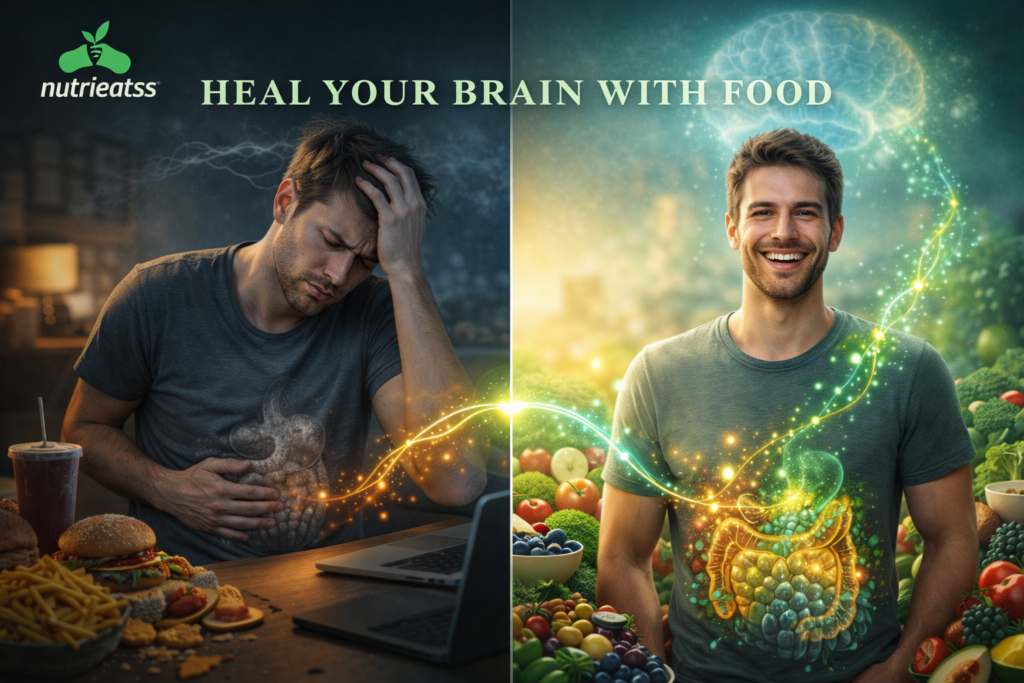
What if your anxiety, brain fog, and low mood have nothing to do with your mindset — and everything to do with what’s happening in your digestive system?
It sounds almost too simple. But a growing body of neuroscience research is making one thing undeniably clear: your gut and your brain are not separate systems. They are in constant, two-way conversation — and the health of your gut may be quietly running (or ruining) your mental health.
If you’ve ever felt inexplicably anxious after a heavy meal, experienced that “gut feeling” of dread before a stressful event, or noticed your mood tank after weeks of poor eating — that wasn’t coincidence. That was your gut-brain axis speaking.
This post breaks down what the science actually says, the warning signs your gut-brain connection may be compromised, and the evidence-based steps you can take starting today.
Disclaimer: This article is for informational purposes only and is not a substitute for professional medical advice. If you’re experiencing persistent mental health symptoms, please consult a qualified healthcare provider.
What Is the Gut-Brain Axis — and Why Should You Care?
For most of medical history, the brain was treated as the body’s command centre — issuing orders downward while the gut quietly digested food below. That model has been turned on its head.
Researchers now understand that the gut and brain communicate constantly through a network called the gut-brain axis — a complex system involving the nervous system, the immune system, hormones, and a remarkable nerve called the vagus nerve.
And here’s the part that surprises most people.
Your Gut Has Its Own Nervous System
Embedded in the walls of your digestive tract is an intricate network of over 500 million neurons — so sophisticated that scientists have given it its own name: the enteric nervous system, or more colloquially, the second brain.
This isn’t a metaphor. Your gut can sense, process information, and respond — largely independently of your brain.
80–90% of Vagus Nerve Signals Travel Upward
The vagus nerve is the longest nerve in your body, running from your brainstem all the way down through your heart, lungs, and into your digestive tract. Most people assume it sends instructions from the brain to the gut.
The reality is the opposite.
Research published in peer-reviewed neuroscience literature consistently shows that approximately 80–90% of vagal fibers carry signals from the gut to the brain — not the other way around. Your gut is essentially filing continuous reports to your brain, influencing your mood, stress response, and cognitive clarity in real time.
The Overlooked Organ: Your Gut Microbiome
Your digestive system is home to approximately 100 trillion microorganisms — bacteria, fungi, viruses, and other microbes — collectively known as the gut microbiome.
This ecosystem is so metabolically active that leading researchers now classify it as an organ in its own right.
What does this microbial community actually do for your brain?
- Produces neurotransmitters — Your gut manufactures approximately 90% of your body’s serotonin, the neurotransmitter most associated with mood stability, emotional regulation, and sleep
- Regulates inflammation — Gut bacteria control systemic inflammation levels, including neuroinflammation directly linked to depression and cognitive decline
- Modulates your stress response — Certain bacterial strains measurably reduce cortisol output and improve resilience under pressure
- Supports the blood-brain barrier — Beneficial bacteria produce compounds called short-chain fatty acids (SCFAs) that strengthen the barrier protecting your brain from inflammatory signals
When your microbiome is diverse and balanced, your brain gets the support it needs. When it’s disrupted — a state called dysbiosis — the downstream effects on your mental health can be significant and, importantly, often go unrecognised.

7 Signs Your Gut-Brain Axis May Be Compromised
These symptoms don’t always look like gut problems on the surface. That’s precisely why they’re so often missed.
1. Brain Fog That Worsens After Eating
If you regularly feel mentally sluggish, unfocused, or “cloudy” within an hour of meals — particularly after processed or high-sugar foods — your gut may be triggering a systemic inflammatory response that crosses into the brain.
2. Anxiety That Flares Alongside Digestive Symptoms
Bloating, cramping, or irregularity that coincides with spikes in anxiety isn’t a strange coincidence. The gut-brain axis runs in both directions — gut distress activates the brain’s stress circuits, and stress worsens gut function. It’s a feedback loop.
3. Depression That Hasn’t Responded Well to Conventional Treatment
Emerging research suggests that a subset of people with treatment-resistant depression may have a significant gut dysbiosis component. A 2019 study published in Nature Microbiology found that certain bacterial genera were consistently depleted in people with depression, independent of antidepressant use.
4. Mood Swings Tied to What You Eat
If your emotional state rises and falls dramatically with your blood sugar — feeling irritable, low, or agitated between meals — this pattern is often amplified by poor microbiome health, which impairs the gut’s ability to regulate blood glucose signalling.
5. Persistent Sleep Problems
Your gut produces the precursors to melatonin — the hormone that regulates your sleep-wake cycle. A disrupted microbiome can impair this production. Worryingly, sleep deprivation then further disrupts microbiome composition within just a few days, creating a self-reinforcing cycle.
6. Chronic Fatigue With No Clear Cause
Many people with medically unexplained fatigue have measurable gut dysbiosis. The microbiome influences mitochondrial function and nutrient absorption — both foundational to cellular energy production.
7. High Stress Sensitivity
If you find yourself unusually reactive to everyday stressors — overwhelmed by things that feel manageable to others — a poorly functioning gut-brain axis may be lowering your baseline stress threshold.
How Food Directly Shapes Your Brain Through Your Gut
This is where the science becomes genuinely actionable.
Fiber-Rich Foods → Fewer Mood Disorders
When you eat dietary fiber, your beneficial gut bacteria ferment it and produce short-chain fatty acids (SCFAs) — particularly butyrate, acetate, and propionate. These compounds reduce neuroinflammation, repair the gut lining, and stimulate production of BDNF (brain-derived neurotrophic factor), a protein critical for neuron growth, learning, and mood regulation.
Studies consistently link higher fiber intake with lower rates of depression and anxiety.
Fermented Foods → Greater Microbiome Diversity
Yogurt, kefir, sauerkraut, kimchi, miso, and kombucha introduce live beneficial bacteria directly into the gut ecosystem and have been shown in clinical research to increase microbiome diversity — one of the strongest predictors of mental health resilience.
A 2021 randomised controlled trial from Stanford University found that a high-fermented food diet significantly reduced inflammatory markers and increased microbiome diversity over just ten weeks.
Ultra-Processed Foods → Neuroinflammation
Foods high in refined sugar, artificial additives, emulsifiers, and seed oils selectively feed inflammatory bacterial species while reducing beneficial ones. They also compromise the gut lining — a condition commonly called intestinal permeability or “leaky gut” — allowing bacterial byproducts to enter the bloodstream and drive inflammation throughout the body, including the brain.
Polyphenol-Rich Foods → Neuroprotection
Berries, olive oil, green tea, dark chocolate, and red grapes contain polyphenols that act as prebiotics — selectively feeding beneficial bacterial species that produce neuroprotective compounds. Regular polyphenol consumption is associated with reduced cognitive decline, lower depression risk, and improved stress response.
A Science-Backed Plan to Heal Your Gut for Better Mental Health
None of these steps require expensive supplements or extreme dietary overhauls. They require consistency.
Step 1: Aim for 30 Different Plant Foods Per Week
This is one of the most robustly supported findings in microbiome science. Research from the American Gut Project — one of the largest citizen science studies of the human microbiome — found that people eating 30+ different plant foods per week had significantly more diverse microbiomes than those eating 10 or fewer.
Diversity of plants equals diversity of beneficial bacteria equals better brain support.
Don’t overthink it. Every different vegetable, fruit, legume, grain, nut, seed, and herb counts as one.
Step 2: Eat Prebiotic Foods Daily
Prebiotics specifically feed your beneficial gut bacteria. Prioritise: garlic, onions, leeks, asparagus, bananas (slightly underripe), oats, apples, flaxseeds, and Jerusalem artichokes.
Even a small daily portion makes a measurable difference over weeks.
Step 3: Add a Fermented Food to at Least One Meal Per Day
It doesn’t have to be large. A tablespoon of kimchi, a small pot of natural yogurt, or a splash of kefir — consumed consistently — contributes meaningfully to microbiome health over time.
Step 4: Ruthlessly Reduce Ultra-Processed Foods
This single change may have the largest impact on both gut and brain health. Ultra-processed foods — those with long ingredient lists containing additives, emulsifiers, and refined oils — actively damage the gut lining and feed the wrong bacteria.
You don’t need to be perfect. Reducing frequency matters.
Step 5: Manage Stress as a Gut Health Intervention
Chronic psychological stress profoundly disrupts the gut microbiome — directly, through the gut-brain axis, and indirectly, through behavioural patterns like disrupted sleep and poor eating. Meditation, breathwork, regular exercise, and time in nature all produce measurable improvements in microbiome composition.
Stress management is not soft advice. It is gut medicine.
Step 6: Protect Your Sleep
Your microbiome has its own circadian rhythm. Sleep deprivation disrupts microbiome composition within days — reducing beneficial species and increasing inflammatory ones. And a disrupted microbiome then worsens sleep quality, creating a cycle that’s difficult to escape without intentionally addressing both sides simultaneously.
The Emerging Science of Psychobiotics
One of the most exciting frontiers in neuroscience right now is psychobiotics — specific probiotic bacterial strains shown in clinical trials to measurably improve mental health outcomes.
Multiple double-blind, placebo-controlled studies have demonstrated that specific strains of Lactobacillus and Bifidobacterium can reduce anxiety scores, improve stress resilience, lower cortisol levels, and alleviate symptoms of mild to moderate depression.
This field is still developing, and it would be premature to recommend specific products. But the evidence is strong enough that a growing number of leading psychiatrists and functional medicine practitioners are beginning to incorporate gut-focused dietary interventions as a core part of mental health treatment — not a fringe add-on.
The Bottom Line
Your mental health and your gut health are not separate conversations.
The trillions of microorganisms living in your digestive system are producing the neurotransmitters your brain runs on, managing the inflammation that either protects or damages your neurons, and filing continuous reports to your brain through one of the most important nerves in your body.
By eating more diverse plant foods, including fermented foods consistently, protecting your sleep, and reducing ultra-processed food intake — you are not just improving your digestion. You are actively reshaping the biochemical environment your brain operates in.
That’s not a small thing.
Your action step this week: Add one new plant food and one fermented food to your daily meals for the next seven days. That’s it. Start there, stay consistent, and pay attention to how you feel.
Sources & Further Reading:
- Cryan, J.F. et al. (2019). “The Microbiota-Gut-Brain Axis.” Physiological Reviews.
- Wastyk, H.C. et al. (2021). “Gut-microbiota-targeted diets modulate human immune status.” Cell.
- Valles-Colomer, M. et al. (2019). “The neuroactive potential of the human gut microbiota in quality of life and depression.” Nature Microbiology.
- McDonald, D. et al. American Gut Project — Human Food Project / UC San Diego.