
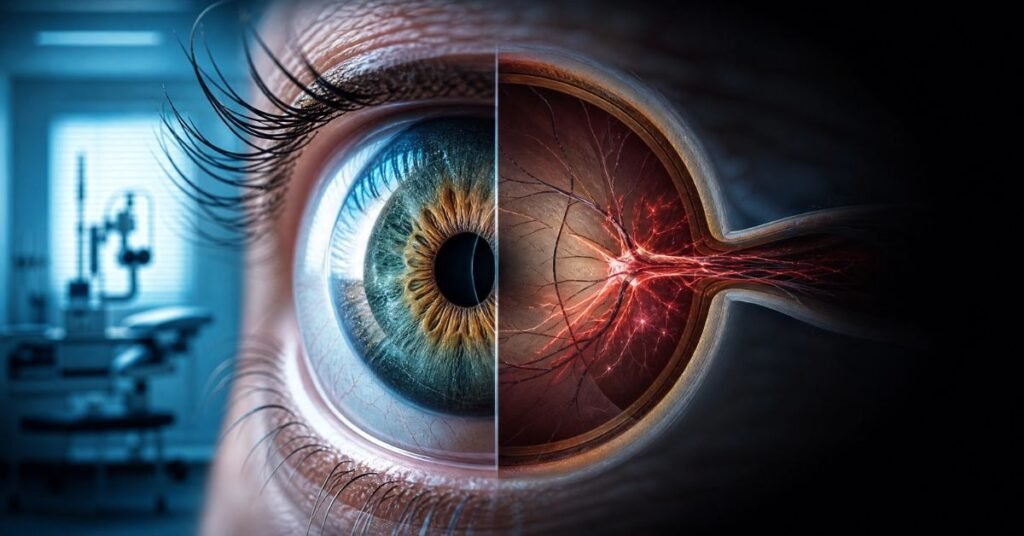
Discover why glaucoma silently steals your vision. Learn the causes, symptoms, diagnosis, treatment options, and how early detection can prevent blindness.
Why Glaucoma Steals 40% of Your Sight Before You Know It-Glaucoma Causes, Symptoms, Diagnosis, and Treatment Options
Today, we need to talk about a condition that, frankly, breaks my heart every time I see it progress. We’re going to be talking about glaucoma. It is often referred to as the silent thief of sight because here’s the devastating reality: people often lose about 40% of their side vision before they even realize that something is going wrong. Think about that for a moment. Forty percent! On top of this, glaucoma is usually a painless condition. You don’t feel a headache, you don’t feel pressure, you don’t feel anything changing with the eye.
You don’t notice your side vision slowly changing, so it often goes unnoticed until it’s truly too late. You only realize the damage after the thief has already left. Now, the good news is that even though damage from glaucoma and vision loss from glaucoma is permanent—we cannot get that nerve back—we are getting incredibly good at detecting it, and our treatments are getting better and better, giving us so much hope. So today, we’re going to be talking about not only what is glaucoma and the two most common types of glaucoma that people are diagnosed with, but then we’ll talk about the various ways we test for it. We’ll also cover the most common treatments—from drops to amazing new lasers—that are now used to help treat and prevent further vision loss from glaucoma in case you or a loved one is ever diagnosed with this condition.
But first, my name is Dr. Joseph Allen. I’m a board-certified doctor of optometry. This channel is all about helping you learn about the eyes, vision, and finding the best vision products. If you are new here, consider hitting the subscribe button down below and turning on the notification bell so that you don’t miss any of our future videos. Otherwise, let’s unlock the secrets of glaucoma.
So, glaucoma is an eye disease that really isn’t just one disease. It’s actually a group of different eye diseases where the optic nerve in the back of the eye gets damaged. You can think of the optic nerve as sort of the data cable that connects the eyeball to the brain. The eye sends data signals to the brain, which the brain interprets, and that gives you your vision. The downside is that when that data cable gets damaged, there are interruptions in the data transmission, and that results in little blind spots in your vision. Most of the time, the damage that occurs to the optic nerve happens because the pressure inside of the eye becomes too high—something we call elevated intraocular pressure or IOP.
Now, let’s use an analogy for this next point. Imagine that the eyeball is like this sink here. Inside the eye, there is a fluid called the aqueous humor that is produced, and it circulates inside the eye to nourish all of the tissues. This aqueous humor is produced and then drains out through what is called the trabecular meshwork. Usually, the production and drainage of this fluid is perfectly balanced. While it’s being produced, it is also draining out of the eye, just like water coming out of the faucet and draining out of the sink. In most types of glaucoma, the drain either gets clogged, or it just doesn’t work as well as it should.
But that faucet keeps running! So what happens is the fluid pressure builds up inside the eye, and that leads to a higher level of eye pressure. That elevated pressure pushes on the nerve in the back of the eye and slowly damages it over time. Now, it’s important to know that while elevated high pressure inside the eye is one of the biggest risk factors for glaucoma, it’s not the whole story. In fact, some people develop glaucoma even with normal eye pressures—something that we call normal tension glaucoma. This could be a result of either somebody having a fragile nerve, or perhaps their blood supply to the optic nerve isn’t very good. But the important thing to remember is that glaucoma is where the nerve progressively gets damaged over time. Even if eye pressure isn’t the primary issue, it’s the biggest risk factor and something that we often try to control with treatments for glaucoma.
So now let’s talk about the different types of glaucoma. The first and most major type of glaucoma is called open-angle glaucoma, and it accounts for about 90% of all cases. This is where the drainage angle inside of the eye is open, just like the name sounds. The problem is that the drain inside of the eye becomes clogged or inefficient in some way, sort of like the sink getting clogged over time. The pressure creeps up so slowly over time that even though it’s causing damage to the nerve, you don’t feel it, and you don’t notice that your side vision is going away until, again, it’s too late. Again, exactly why they call it the silent thief of sight.
Risk factors for this type of glaucoma include being over the age of 40, having a family member who has glaucoma, also having any sort of African or Hispanic descent, or having health conditions such as diabetes. Now, next, let’s talk about a different type of glaucoma called angle closure glaucoma. While angle closure doesn’t happen as often, it is much more dramatic and urgent. This is where the iris inside of the eye usually bows forward and physically closes off the angle inside of the eye, which results in a very rapid rise in eye pressure.
Sort of like putting a physical stopper in the drain of a sink. And unlike the silent cousin of open angle glaucoma, an acute angle closure attack results in sudden and painful symptoms. This includes not only eye pain but an extreme headache. People often see sort of like halos and blurry vision around lights. Then, people may even have nausea and vomiting. And I mention all of this because it is considered a true medical emergency. If you’re having any of these sort of symptoms, it’s important to call your eye doctor and get seen right away. Because with elevated eye pressure spiking as fast as it does, if we don’t lower the pressure quickly, it can result in permanent vision loss, even in just a few hours. Usually, the people who are at highest risk of an angle closure attack are women who are over the age of 65 and happen to be farsighted.
so now that we’ve talked about the different types of glaucoma, let’s talk about the different tests that doctors will do or order in order to not only diagnose glaucoma, but also manage and follow it over time. Because if you’re going to be assessed for glaucoma, it’s probably good for you to be familiar with what we’re doing and why we’re doing it. 1. Tonometry (Measuring Pressure): The first test that you’re probably going to see is called tenometry. This is where we physically measure the pressure of the inside of the eye. You may recall an older test called the Airpuff test. But some more modern clinics, like the one we have here, use a handheld rebound tonometer that just sort of reaches out and tickles the surface of the eye, which you can barely feel.

Otherwise, doctors often use a blue light shined onto a tonometer probe that just barely touches the surface of the eye with some anesthetic to numb the eye. That gives us a very accurate reading. An eye pressure that’s considered normal is between 10 and 21 mm of mercury. If anybody’s eye pressure is above 21, that may be a red flag. 2. Gonioscopy (Checking the Drain): Another test you’ll probably see is called gonioscopy. This is where your doctor will put a specialized contact lens on the surface of the eye that has some mirrors on it. This allows the doctor to look at the drainage angle inside of the eye to determine how open or closed it may be. 3. OCT Imaging (The MRI of the Eye): Now, some imaging tests that doctors often use include not only taking photographs of the optic nerves, but now there’s some newer technology called an OCT, or an optical coherence tomographer.
This sort of scanning technology gives us almost like an MRI of the tissue in the back of the eye, including showing us specific parts of the nerve that can be damaged due to glaucoma. In fact, we can catch certain patterns of nerve loss that will tell us if somebody’s probably developing glaucoma years before they actually experience any vision loss. Most modern-day glaucoma evaluations include some form of OCT imaging because it is so sensitive and good for picking up early detection in glaucoma. 4. Visual Field Test (Mapping the Damage): The other test that we most commonly use for glaucoma, that of visual field or automated perimetry, is where you look through a visual field sort of test. It basically sends little light flashes to the sides of your vision, and you click a button whenever you think you saw something show up.
It helps map out your side vision with really high accuracy. But I will admit that test can be really frustrating as a user because it kind of gives you some anxiety, like, did you see that flash of light or not? Thankfully, the profession does have a lot of new virtual reality headsets that are being adopted for this testing, and that’s making it much more efficient and user-friendly. 5. ERG/VEP (Electrical Signal Check): One last test I thought I’d mention is that of an ERG or an electroretinogram. There’s evidence that just with those tests alone, they can detect glaucoma up to about seven years in advance. It tells us a lot about the health of the nerve, the retina, and the structures between the eye and the brain. Now, depending on somebody’s risk for glaucoma, your doctor may ask or order these tests to be done maybe once a year, to sometimes four times a year or more for more aggressive or severe types of glaucoma.
One other side comment I’ll just put in here as a doctor who practices here in the United States is that insurance companies sometimes dictate which tests we can order on which dates. They won’t let us just do all of these tests at once.
They sometimes make us kind of have people back on a different day to order a different test. I don’t think there’s any logical reasoning behind that, but that’s the way the system works right now. So, you may have to talk with your doctor, and they may be ordering tests and having you come back at different times so that they don’t have to send you a bill for like a cash pay option to do all those tests. I just want you to be aware that that is an issue, and that’s why that happens.
So, now let’s talk about treatments for glaucoma. Because if you or loved ones are diagnosed with glaucoma, you want to know: how do you stop things? How do you keep your eyes seeing the best as they can? Because unfortunately with glaucoma, once nerve damage has been done, there’s no way of getting it back. But the good news is that our treatments to lower the eye pressure and to stabilize the eye and prevent it from losing more vision in the future—we’ve gotten really good with that. Now for most eye doctors, we have three major tools in our toolbox to treat glaucoma: laser therapies, medications, and then more invasive surgical procedures.
- Medications (Eye Drops): Historically, a lot of glaucoma treatment revolved around the use of prescription eye drops to lower the eye pressure. The drops either would shut off the faucet in a way and reduce the amount of aqueous being produced inside of the eye, or it would clean up and improve the outflow through the drainage structures inside of the eye. Either way, if you’ve ever been prescribed an eye drop medication, or doctors do prescribe you something in the future for glaucoma, it’s really important to follow the instructions given to you by your doctor. A key side note: a lot of these medications are known to have side effects of causing more irritation to the ocular surface, including some of the preservatives in those medications. That means people who take them are at a higher risk of developing ocular surface disease, or otherwise known as dry eye disease. Because of that, I think it’s important to talk with your eye doctor if they’re putting you on these medications, if it’s something that maybe comes in a preservative-free formulation, or if they think maybe you’re a candidate for a different type of eye pressure control. I also want to mention Nanodropper, an attachment that goes on to a lot of eye drop medications for glaucoma and makes the size of the drop that comes out of the bottle smaller, reducing the side effect profile from those drops hitting the surface of the eye.
- Laser Therapy (The Modern Approach): Now, new research has shown that laser therapies are not only common, but they’re efficient and safe for treating glaucoma. It has largely become the first-line treatment for people who are candidates for it because it can be done quickly in the clinic, eliminating the worry of daily drops and side effects. For open-angle glaucoma, the procedure is called an SLT, or selective laser trabeculoplasty. The laser doesn’t burn a hole; it activates your own immune cells, and your own immune cells clean out the cellular garbage that is clogging the drain inside the eye. What’s great is it can be repeated years down the road. For the people who are at risk of angle closure, there’s another laser procedure called an LPI, or a laser peripheral iridotomy. This creates a small hole in the iris, which allows any of the trapped pressure to escape.
- Surgery (The Last Resort): For people who have either severe cases of glaucoma or really stubborn cases that don’t respond well to the other treatments, then there are more advanced surgical procedures. This includes MIGs, or minimally invasive glaucoma surgeries, where they implant a microscopic drainage tube inside of the eye. For even more severe cases, there are more traditional glaucoma surgeries such as a trabeculoplasty or tube shunts, where they have to physically create a new channel for the fluid inside the eye to drain out and lower that pressure. Thankfully, research is always ongoing. We even now have an implanted medication that can be put inside the eye so that you get a continuous release of medication for months at a time without having to use any eye drop medications. So, who knows what we’re going to have in the future. It’s always important to ask your doctor what is new and what they think is going to be best for you.
Now, I know we covered a lot in today’s video, but the big key takeaway I hope that you walk away with is that early detection is key, especially for anybody over the age of 40. If you haven’t had an eye exam in the last year, please call your local eye doctor and schedule a full dilated eye exam. That’s the best way for us to catch glaucoma and catch it before vision loss really begins.
If we can stop even just one person from developing glaucoma or having vision loss, then this entire video is worth it, and I have done my job. Now, if you happen to find value in today’s video, please do me a favor and hit that like button down below and subscribe to the channel if you are new. I know a common question that a lot of my patients ask is if there’s anything lifestyle-wise that they can naturally be doing to either lower their eye pressure or reduce their chances of developing glaucoma.
This was a good question for me because it wasn’t something really covered in my traditional schooling. So, I’ve actually dove into the research and have found some interesting publications. We’re going to be producing some videos on exactly that. So, again, make sure you subscribe to the channel and turn on that bell so you don’t miss any of those future videos. But until then, keep an eye on it, and we’ll see you in those next ones.