
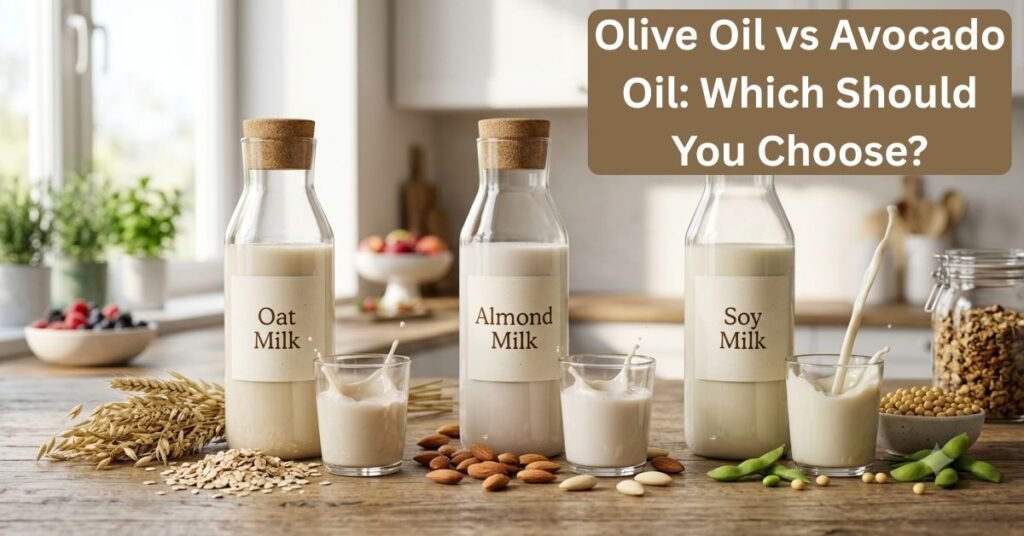
Oat milk vs. almond milk vs. soy milk—compare calories, protein, and nutrients to find your healthiest dairy-free pick today.
Walk down the milk aisle today and you’ll find a wall of cartons that has nothing to do with cows. Oat, almond, soy, pea, hemp, coconut — plant-based milk has gone from niche to mainstream in less than a decade, and grocery shelves have expanded to match the demand.
The reasons people switch vary. Some are lactose intolerant. Some follow a vegan or plant-based diet. Others are simply curious, or looking for something that fits better with their health goals. Whatever the reason, one question tends to come up almost immediately: which plant milk is actually the healthiest?
It’s a fair question, and the honest answer is: it depends. Oat, almond, and soy milk each bring something different to the table nutritionally. One is closest to dairy in protein. One is the lightest in calories. One is prized for its creamy texture. None of them is universally “best” — the right choice depends on your goals, your diet, and what you’re using the milk for.
This guide breaks down the science behind all three, compares them side by side, and helps you figure out which one actually fits your life.
What Is Plant-Based Milk?
Plant-based milk is a dairy-free beverage made by blending a plant source — oats, almonds, or soybeans — with water, then straining out the solids. The resulting liquid is often fortified with nutrients like calcium, vitamin D, and vitamin B12 to help it more closely match the nutritional profile of cow’s milk, since these nutrients aren’t naturally abundant in the base plant ingredient at the same levels.
A few things to know before you compare labels:
- Unsweetened versions contain no added sugar, only naturally occurring carbohydrates from the plant source.
- Sweetened and flavored versions (vanilla, chocolate) can add anywhere from 5 to 15 grams of added sugar per cup.
- Fortification varies by brand. Two cartons labeled “oat milk” can have very different calcium or protein content depending on how they’re formulated.
- Added oils and gums are common in oat and some almond milks to improve creaminess and shelf stability — worth checking if you’re minimizing processed ingredients.
Always check the nutrition label rather than assuming; formulations differ significantly between brands.
Oat Milk Overview
Oat milk is made by soaking and blending oats with water, then straining the mixture. It has become one of the most popular plant milks in recent years, largely thanks to its texture.
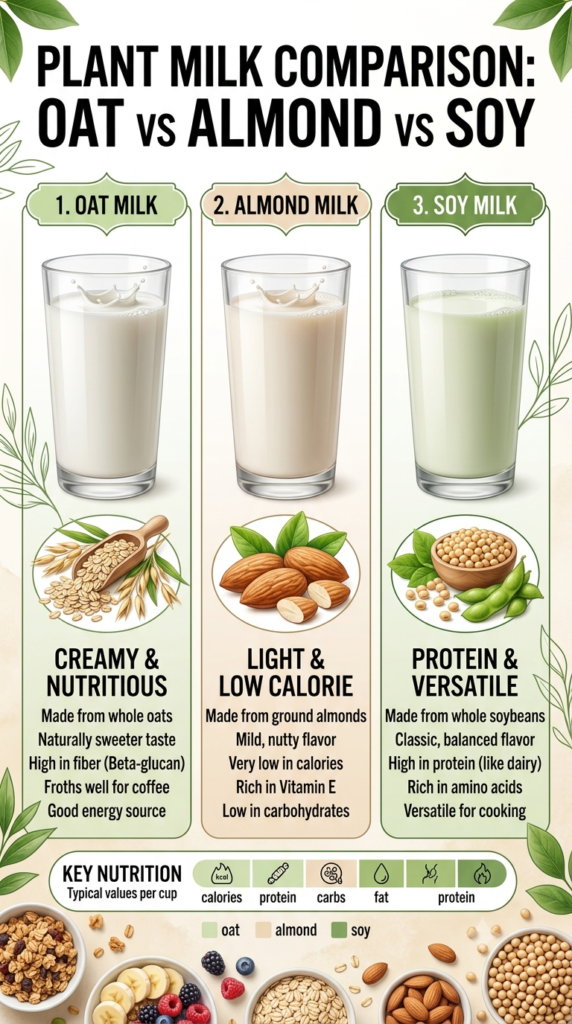
Nutrition: A typical cup of unsweetened oat milk provides around 120 calories, 3 grams of protein, 2–5 grams of fat, and roughly 16 grams of carbohydrates, including natural fiber from the oats.
Fiber (beta-glucan): Oats contain a soluble fiber called beta-glucan, which has research support for helping lower LDL cholesterol. Some, but not all, of this fiber carries through into the milk, depending on processing.
Creamy texture: Oat milk froths and steams well, which is a major reason it has become the default choice at many coffee shops.
Taste: Naturally sweet and neutral, making it approachable even for people new to plant-based milk.
Best uses: Coffee and lattes, baking, and pouring over cereal, where its creaminess and mild sweetness shine.
Potential downsides: Oat milk tends to be higher in calories and carbohydrates than almond milk, and some brands add canola or rapeseed oil to enhance mouthfeel — worth noting if you’re watching added fats.
Almond Milk Overview
Almond milk is made by blending almonds (or almond butter) with water and straining out the solids, which also removes most of the fiber and protein naturally found in whole almonds.
Nutrition: Unsweetened almond milk is typically the lowest-calorie plant milk, often around 30–40 calories per cup, with about 1 gram of protein and 2–3 grams of fat.
Low calories: This makes almond milk a popular pick for people managing calorie intake.
Healthy fats: The small amount of fat present is mostly unsaturated, in line with almonds’ naturally heart-friendly fat profile.
Vitamin E: Almond milk is naturally higher in vitamin E than oat or soy milk, an antioxidant that supports skin and cell health.
Taste: Light, slightly nutty, and thinner in texture than oat or soy milk.
Best uses: Smoothies, cereal, and lighter recipes where a thinner consistency isn’t a drawback.
Potential downsides: Very low in protein — often just 1 gram per cup — which makes it a poor stand-in for dairy milk if protein intake matters to you. It’s also thinner and less stable in hot coffee than oat or soy milk.
Soy Milk Overview
Soy milk is made from soybeans (or soy protein isolate) blended with water. Of the three, it’s nutritionally the closest match to cow’s milk.
Nutrition: A cup of unsweetened soy milk generally provides around 80–110 calories, 7–8 grams of protein, 4 grams of fat, and 4 grams of carbohydrates.
Complete protein: Soy is one of the few plant proteins considered “complete,” meaning it contains all nine essential amino acids in meaningful amounts — a key reason soy milk is often recommended for vegans and vegetarians who need reliable plant protein sources.
Heart health: Soy protein has research backing for modestly supporting healthy cholesterol levels as part of a heart-conscious diet.
Isoflavones: Soy naturally contains isoflavones, plant compounds that have been studied for potential benefits related to hormone health and bone density. Research on isoflavones is ongoing, and evidence continues to evolve.
Taste: A slightly beany, more distinct flavor than oat or almond milk, though modern formulations have largely minimized this.
Best uses: A dairy milk replacement in recipes, smoothies where protein matters, and as a daily drink for those wanting a protein boost.
Potential downsides: The flavor can be an adjustment for some people, and soy allergies, while less common than nut or dairy allergies, do exist.
Nutrition Comparison Table
Approximate values per 1 cup (240 mL), unsweetened, original varieties. Actual values vary by brand and fortification — always check the label.
| Nutrient | Oat Milk | Almond Milk | Soy Milk |
| Calories | ~120 | ~30–40 | ~80–110 |
| Protein | ~3 g | ~1 g | ~7–8 g |
| Fat | ~2–5 g | ~2–3 g | ~4 g |
| Carbohydrates | ~16 g | ~1–2 g | ~4 g |
| Fiber | ~1–2 g | ~0–1 g | ~1 g |
| Calcium (fortified) | ~350 mg | ~450 mg | ~300–450 mg |
| Vitamin D (fortified) | ~2–3 mcg | ~2–3 mcg | ~2–3 mcg |
| Vitamin B12 (fortified) | Often added | Often added | Often added |
| Vitamin E | Low | Higher | Moderate |
| Magnesium | Low–moderate | Low | Moderate |
| Potassium | Low–moderate | Low | Moderate–high |
| Added sugar (unsweetened) | 0 g | 0 g | 0 g |
Fortification is the biggest variable here — always check the label, since calcium, vitamin D, and B12 content depend entirely on manufacturer formulation rather than the base plant ingredient.
Which Milk Is Best For…
Weight Loss
Unsweetened almond milk is typically the lowest-calorie option, which can help if you’re managing total calorie intake. That said, calories alone don’t determine weight management success — overall diet quality matters more.
Muscle Building
Soy milk is the clear winner here, offering roughly seven times the protein of almond milk and about double that of oat milk, making it a more meaningful contributor to daily protein targets.
Diabetes
Unsweetened almond milk’s minimal carbohydrate content makes it a common choice for blood sugar management, though unsweetened soy milk is also a reasonable option due to its moderate carbs and higher protein, which can help slow blood sugar response. Oat milk, being naturally higher in carbohydrates, warrants more attention to portion size for people managing blood sugar.
Heart Health
Both oat milk (via beta-glucan fiber) and soy milk (via soy protein) have research support for modestly favorable effects on cholesterol. Choosing unsweetened versions of either is a reasonable heart-conscious choice.
Bone Health
Fortified versions of any of the three can support bone health through added calcium and vitamin D. Soy milk has the added benefit of isoflavones, which some research links to bone density support, though more research is needed to confirm the extent of this effect.
Gut Health
Oat milk’s beta-glucan fiber can act as a mild prebiotic, supporting beneficial gut bacteria. Almond and soy milk contain less fiber overall, since much of it is removed during straining.
Children
Plant milks can be part of a child’s diet, but pediatric guidance generally cautions against relying on them as a primary milk substitute for young children without professional guidance, since they may not match whole or fortified dairy milk in calories, fat, and protein needed for growth. A pediatrician or registered dietitian can help tailor the right choice.
Seniors
Protein and calcium needs often increase with age. Fortified soy milk is frequently recommended for older adults due to its higher protein content alongside calcium fortification.
Pregnancy
Fortified, unsweetened options are generally preferred, with attention to adequate protein and calcium intake. As with any major dietary choice during pregnancy, it’s worth discussing with a healthcare provider.
Coffee & Lattes
Oat milk is widely favored for coffee because it froths well and holds up to heat without curdling, giving it a texture closest to steamed dairy milk.
Smoothies
Soy milk’s higher protein content makes it a strong smoothie base, especially for post-workout drinks. Almond milk works well when a lighter, lower-calorie base is preferred.
Baking
Oat milk’s creaminess and mild sweetness make it a popular substitute in baked goods. Soy milk’s higher protein content can also support structure in recipes like pancakes.
Cooking
Soy milk holds up well in savory cooking due to its protein and body. Oat milk works nicely in creamy sauces and soups.
Cereal
Oat milk’s naturally sweet, thick texture makes it a favorite for cereal, closely mimicking the mouthfeel of dairy milk.
Pros and Cons
Oat Milk
Advantages
- Creamy texture, ideal for coffee
- Contains beta-glucan fiber
- Naturally sweet, mild flavor
- Widely available at coffee shops
Disadvantages
- Higher in calories and carbs than almond milk
- Lower protein than soy milk
- Some brands include added oils
Almond Milk
Advantages
- Lowest in calories
- Naturally rich in vitamin E
- Light, mild flavor
- Works well in smoothies and cereal
Disadvantages
- Very low in protein
- Thinner texture, less ideal for coffee
- Almost no fiber after straining
Soy Milk
Advantages
- Highest protein of the three
- Complete amino acid profile
- Closest nutritional match to dairy milk
- Contains isoflavones
Disadvantages
- More distinct flavor than oat or almond milk
- Possible allergen for some individuals
- Some people prefer to limit soy for personal or health reasons, though evidence does not support broad safety concerns for most adults
Environmental Impact
Sustainability is a major reason many people choose plant-based milk in the first place. Here’s how the three compare generally:
- Water use: Almond milk requires notably more water to produce than oat or soy milk, largely due to almond trees’ high water needs during cultivation.
- Land use: Oat and soy milk generally require less land per liter produced compared to almond milk and considerably less than dairy milk.
- Greenhouse gas emissions: All three plant milks produce substantially lower greenhouse gas emissions than dairy milk, with oat milk often cited as having one of the smallest carbon footprints among common plant milks.
- Packaging: Most plant milks come in recyclable cartons or bottles, though recyclability depends on local waste programs and carton composition.
- Sustainability: Oat milk is frequently highlighted as a strong overall choice for environmental impact, thanks to oats’ relatively low water and land requirements.
If environmental footprint is a top priority, oat and soy milk generally edge out almond milk, primarily due to water use.
How to Choose the Best Plant Milk
Match your choice to your priority:
- High protein → Soy milk
- Lowest calories → Almond milk
- Creamiest texture → Oat milk
- Heart-friendly → Unsweetened soy or oat milk
- Weight management → Unsweetened almond milk
- Vegan nutrition needs → Fortified soy milk
- Best for coffee → Oat milk (barista blends specifically)
- Lowest environmental footprint → Oat or soy milk
There’s no universal winner — the “best” milk is the one that matches your specific goal.
Common Buying Mistakes
- Choosing sweetened versions by default. Sweetened plant milks can add significant sugar you may not need.
- Ignoring the ingredient list. A short, recognizable ingredient list is generally a good sign; long lists of stabilizers and gums are worth a second look.
- Overlooking low-protein options when protein intake actually matters for your goals.
- Assuming all brands are fortified equally. Calcium and vitamin D levels vary significantly — check the label rather than assuming.
- Not noticing added oils. Some oat and almond milks add oil for creaminess, which increases calories without adding much nutritional value.
- Overlooking sodium content, which can vary meaningfully between brands.
Myth vs. Fact
Myth: “All plant milks have the same nutrition as dairy milk.” Fact: None of the three matches dairy milk exactly. Soy milk comes closest in protein, but calcium and vitamin content still depend on fortification.
Myth: “Soy milk affects hormone levels in a harmful way.” Fact: Major health organizations, including the American Cancer Society and Academy of Nutrition and Dietetics, note that moderate soy consumption is considered safe for most people, and concerns about isoflavones significantly disrupting hormones in humans are not well supported by current evidence.
Myth: “Oat milk is inflammatory because of its carbohydrate content.” Fact: There’s no strong scientific evidence that oat milk itself causes inflammation in most people. Oats are a whole-grain source with fiber that’s generally considered supportive of health, not harmful.
Myth: “Unsweetened means no sugar at all, always.” Fact: “Unsweetened” means no added sugar, but small amounts of natural sugar can still appear from the base ingredient, particularly in oat milk due to starch breakdown during processing.
Frequently Asked Questions (FAQ)
Which plant milk is healthiest?
There’s no single answer—it depends on your goals. Soy milk generally offers the most balanced nutrition profile, closest to dairy milk, especially for protein.
Is soy milk healthier than oat milk?
Soy milk generally has more protein and fewer carbohydrates than oat milk, making it a stronger nutritional match for dairy milk. Oat milk offers unique fiber benefits and a creamier texture that some people prefer.
Is almond milk better for weight loss?
Its low calorie count can support a reduced-calorie diet, but weight loss depends on total daily intake and overall diet quality, not one ingredient alone.
Which milk has the most protein?
Soy milk, with roughly 7–8 grams per cup compared to about 3 grams in oat milk and about 1 gram in almond milk.
Which milk tastes most like dairy?
Oat milk is often described as closest in creaminess, while soy milk is often considered closest in overall richness and mouthfeel.
Can children drink plant milk?
Yes, as part of a varied diet, though plant milks generally shouldn’t fully replace whole dairy milk for young children without guidance from a pediatrician, since nutrient and calorie needs differ by age.
Is oat milk inflammatory?
No strong evidence supports this claim for most people. Oats are a whole grain with a favorable nutrition profile.
Which milk is best for cholesterol?
Both oat milk (via beta-glucan) and soy milk (via soy protein) have research suggesting modest support for healthy cholesterol levels.
Which milk is best for coffee?
Oat milk, particularly barista-blend versions, is widely preferred for its ability to froth and hold texture in hot beverages.
Which plant milk is best for diabetics?
Unsweetened almond or soy milk tend to be better choices due to lower carbohydrate content, though individual blood sugar response can vary, so checking with a healthcare provider or dietitian is worthwhile.
Key Takeaways
- Soy milk offers the highest protein and is a nutritionally strong dairy alternative, closest to cow’s milk overall.
- Almond milk is typically the lowest in calories, making it popular for calorie-conscious diets, but it’s very low in protein.
- Oat milk provides a creamy texture and contains beta-glucan fiber that may support heart health, though it’s higher in calories and carbs than almond milk.
- Fortified, unsweetened versions of any of the three are generally the smartest choices.
- The healthiest option ultimately depends on your individual nutrition needs, goals, and taste preferences.
Conclusion
There’s no single “best” milk that wins across every category — and that’s actually good news, because it means you can choose based on what matters most to you. If protein is your priority, soy milk is hard to beat. If you’re counting calories, almond milk is the lightest option. If you love a creamy latte or a bowl of cereal that tastes indulgent, oat milk delivers on texture in a way the others don’t.
Whichever you choose, look for unsweetened, fortified versions with a short ingredient list, and don’t be afraid to try more than one — many people end up keeping two on hand for different purposes, like soy milk for smoothies and oat milk for coffee.
This article is intended for general educational purposes and is not a substitute for personalized advice from a doctor or registered dietitian, especially if you have specific health conditions, allergies, or nutritional needs.
Which plant-based milk do you reach for most often? Share your favorite in the comments, and subscribe for more evidence-based nutrition guides. Explore our related articles on dairy-free nutrition, healthy eating swaps, and plant-based living.