
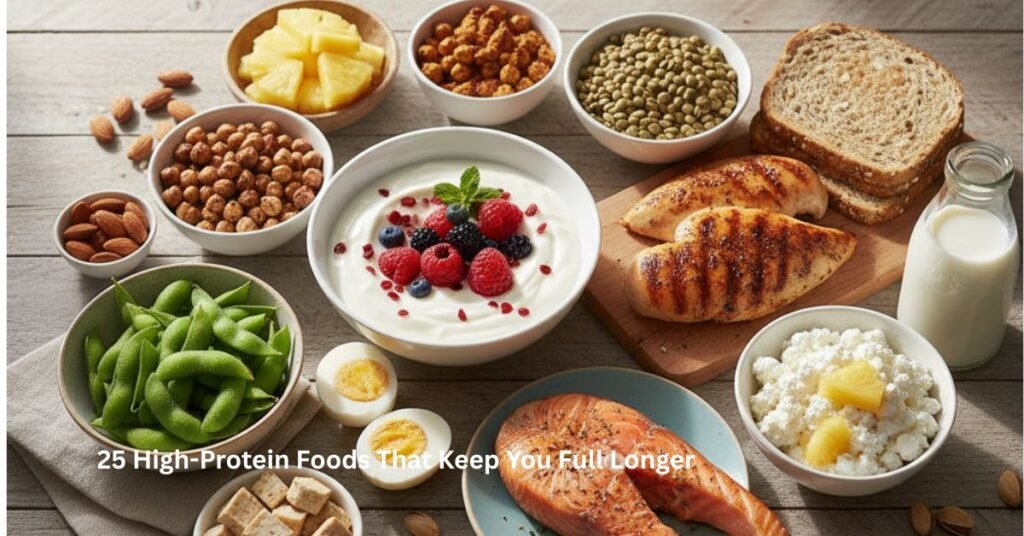
Discover 25 high-protein foods that keep you full longer, curb cravings, and support weight loss — plus a meal plan, snack ideas, and expert tips.
High-protein foods are one of the simplest, most research-backed tools for staying full longer, curbing cravings, and supporting steady, sustainable weight loss. Protein slows digestion, blunts hunger hormones, and helps stabilize blood sugar, so you’re not white-knuckling your way through the afternoon slump.
In this guide, you’ll find 25 high-protein foods that keep you full longer, why they work, how much protein you actually need, a full day of high-protein meal ideas, snack options that fight cravings, and answers to the most common questions about eating more protein — safely and sustainably. Whether you’re new to fitness, juggling a demanding job, or simply tired of feeling hungry an hour after eating, this article will help you build a more satisfying, protein-forward plate.
Why Protein Keeps You Full Longer
Not all calories affect hunger the same way. Gram for gram, protein is the most filling of the three macronutrients — more than carbohydrates and more than fat. Here’s what’s happening in your body when you eat it.
Protein digests slowly. Unlike simple carbohydrates, which break down quickly and cause a fast spike-and-crash in blood sugar, protein takes longer for your stomach and small intestine to break down. That slower digestion means food stays in your stomach longer, which naturally delays the return of hunger.
It triggers satiety hormones. Eating protein stimulates the release of GLP-1 (glucagon-like peptide-1) and PYY (peptide YY), two hormones produced in the gut that signal “fullness” to the brain. Higher levels of these hormones after a meal are directly linked to reduced appetite and less snacking later in the day.
It lowers ghrelin. Ghrelin is often called the “hunger hormone” because it’s what makes your stomach growl and your brain start thinking about food. Protein-rich meals suppress ghrelin more effectively than meals high in carbs or fat, which is part of why a protein-heavy breakfast can carry you further into the day than a bowl of cereal.
It has a higher Thermic Effect of Food (TEF). Your body burns calories just to digest, absorb, and metabolize food. Protein has the highest thermic effect of the three macronutrients — your body uses roughly 20–30% of protein’s calories just processing it, compared to 5–10% for carbs and 0–3% for fat. That means a portion of the calories from a high-protein meal are essentially “spent” before they can be stored.
It stabilizes blood sugar. Pairing protein with carbohydrates slows the absorption of glucose into the bloodstream, preventing the sharp spikes and crashes that often trigger cravings and impulsive snacking.
It preserves muscle mass. During weight loss, your body can break down muscle tissue for energy if protein intake is too low. Adequate protein — especially when paired with resistance training — helps preserve lean muscle while you lose fat, which keeps your metabolism working in your favor.
Did You Know? Studies on high-protein diets have found that increasing protein intake to around 25–30% of total daily calories can reduce cravings by up to 60% and cut the desire for late-night snacking nearly in half.
How Much Protein Do You Really Need?
Protein needs vary depending on age, activity level, and goals. The commonly cited RDA (Recommended Dietary Allowance) is a minimum to prevent deficiency — not necessarily the ideal amount for satiety, muscle maintenance, or weight loss.
Quick Tip: A simple starting target for most active adults trying to manage weight is 0.7–1 gram of protein per pound of body weight per day (roughly 1.6–2.2 g/kg), spread across three to four meals.
Protein Needs by Group
| Group | General Recommendation | Notes |
| Sedentary adults (RDA baseline) | 0.36 g per lb body weight (0.8 g/kg) | Minimum to prevent deficiency, not optimal for satiety |
| Active adults | 0.6–0.9 g per lb (1.2–2.0 g/kg) | Supports muscle repair and appetite control |
| Adults over 40 | 0.5–0.8 g per lb (1.0–1.2+ g/kg) | Helps offset age-related muscle loss (sarcopenia) |
| Weight-loss focused | 0.7–1.0 g per lb (1.6–2.2 g/kg) | Higher protein preserves muscle during a calorie deficit |
| Per meal (for satiety) | 25–40 grams | Amounts below ~20g per meal show weaker satiety effects |
These are general guidelines, not medical prescriptions. People with kidney disease or other health conditions should talk to a doctor or registered dietitian before significantly increasing protein intake (more on this in the Safety Considerations section).
25 High-Protein Foods That Keep You Full Longer
These 25 high-protein foods span animal and plant sources, so there’s an option here no matter how you eat. For each one, you’ll find the protein content, calories, key nutrients, and practical tips for adding it to your routine.
1. Eggs
Protein: ~6g per large egg | Calories: ~70
Eggs are one of the most nutrient-dense foods available, packed with choline, vitamin D, and high-quality protein containing all nine essential amino acids. Because the protein and fat in eggs digest slowly, they help stave off hunger for hours — research has shown an egg breakfast can reduce calorie intake later in the day compared to a bagel with the same calorie count.
Best way to eat it: Hard-boiled for grab-and-go snacks, or scrambled with vegetables for a filling breakfast. Shopping tip: Pasture-raised or omega-3 enriched eggs offer a slightly better fat profile, but any eggs deliver the core protein benefits.
2. Greek Yogurt
Protein: ~15–20g per 3/4 cup | Calories: ~100–150
Greek yogurt is strained to remove excess whey, which concentrates the protein and reduces sugar compared to regular yogurt. It also delivers probiotics that support gut health, which is increasingly linked to appetite regulation.
Best way to eat it: Plain, topped with berries and a sprinkle of nuts to add fiber and healthy fat. Shopping tip: Choose plain over flavored varieties — flavored yogurts can carry as much sugar as a candy bar.
3. Cottage Cheese
Protein: ~24–28g per cup | Calories: ~180
Cottage cheese is mostly casein, a slow-digesting protein that releases amino acids gradually over several hours — one reason it’s a popular bedtime snack among athletes. It’s also rich in calcium and B12.
Best way to eat it: With pineapple or tomatoes and cracked pepper for a savory twist. Shopping tip: Look for low-sodium versions if you’re watching salt intake.
4. Chicken Breast
Protein: ~26g per 3.5 oz (100g) cooked | Calories: ~165
Chicken breast is a lean-protein staple for good reason: high protein, low fat, and versatile enough to work in almost any cuisine. Its high protein-to-calorie ratio makes it especially useful for weight management.
Best way to eat it: Grilled, baked, or shredded into salads, wraps, or grain bowls. Shopping tip: Buy in bulk and batch-cook on a Sunday to make weekday meals easier.
5. Turkey Breast
Protein: ~24g per 3.5 oz cooked | Calories: ~135
Turkey breast is similar to chicken but slightly leaner, and it’s rich in tryptophan and B vitamins that support energy metabolism.
Best way to eat it: Sliced for sandwiches, or ground into lean turkey burgers and chili. Shopping tip: Check labels on deli turkey — many brands add sodium and fillers; opt for “100% turkey breast” varieties.
6. Salmon
Protein: ~22g per 3.5 oz cooked | Calories: ~206
Salmon combines high-quality protein with omega-3 fatty acids, which have been linked to reduced inflammation and improved heart health. The combination of protein and healthy fat makes it especially satiating.
Best way to eat it: Baked with lemon and herbs, or flaked over a salad. Shopping tip: Wild-caught tends to have a slightly better omega-3 profile, but frozen or canned salmon is a budget-friendly alternative with similar protein content.
7. Tuna
Protein: ~25g per 3.5 oz (canned in water) | Calories: ~130
Tuna is one of the most convenient high-protein foods, with an excellent protein-to-calorie ratio and virtually no prep required.
Best way to eat it: Mixed with Greek yogurt instead of mayo for a tuna salad, or straight from the can with crackers. Shopping tip: Choose tuna canned in water rather than oil to keep calories lower, and look for “light” tuna, which is typically lower in mercury than albacore.
8. Sardines
Protein: ~23g per 3.5 oz | Calories: ~208
Small but mighty, sardines deliver protein, omega-3s, and one of the highest calcium contents of any fish (thanks to their edible bones).
Best way to eat it: On whole-grain toast with a squeeze of lemon, or tossed into pasta. Shopping tip: Sardines packed in olive oil or water are generally better choices than those in heavy sauces.
9. Shrimp
Protein: ~24g per 3.5 oz | Calories: ~99
Shrimp is one of the leanest high-protein foods around — very high protein with minimal fat and calories, making it a favorite for weight-management diets.
Best way to eat it: Sautéed with garlic and vegetables, or added to salads and grain bowls. Shopping tip: Frozen, deveined shrimp is convenient, budget-friendly, and just as nutritious as fresh.
10. Lean Beef
Protein: ~26g per 3.5 oz cooked (90/10) | Calories: ~184
Lean beef provides complete protein along with iron, zinc, and vitamin B12 — nutrients that can be harder to get enough of on lower-protein diets, especially for menstruating individuals.
Best way to eat it: Choose cuts like sirloin, tenderloin, or 90%+ lean ground beef. Shopping tip: Trim visible fat and opt for grilling, roasting, or broiling over frying to keep it lean.
11. Lentils
Protein: ~18g per cooked cup | Calories: ~230
Lentils are a plant-protein powerhouse, and their high fiber content (about 15g per cup) adds a second layer of satiety on top of the protein itself — fiber slows digestion and helps you feel full for longer.
Best way to eat it: In soups, stews, or as a base for veggie burgers. Shopping tip: Dried lentils are the most economical option and cook in about 20 minutes without soaking.
12. Chickpeas
Protein: ~15g per cooked cup | Calories: ~270
Chickpeas combine protein and fiber with a satisfying, slightly nutty flavor that works in both savory and roasted-snack forms.
Best way to eat it: Blended into hummus, tossed into salads, or roasted with spices for a crunchy snack. Shopping tip: Rinse canned chickpeas well to reduce added sodium.
13. Black Beans
Protein: ~15g per cooked cup | Calories: ~227
Black beans are rich in both protein and resistant starch, a type of fiber that feeds beneficial gut bacteria and supports steady blood sugar.
Best way to eat it: In burrito bowls, soups, or a simple black bean and corn salad. Shopping tip: Canned beans are a convenient staple — just rinse to cut sodium by up to 40%.
14. Edamame
Protein: ~17g per cooked cup | Calories: ~189
Edamame (young soybeans) is a complete plant protein, meaning it contains all nine essential amino acids — a rarity among plant foods.
Best way to eat it: Steamed and lightly salted as a snack, or added to stir-fries and grain bowls. Shopping tip: Frozen edamame (shelled or in-pod) keeps well and cooks in minutes.
15. Tofu
Protein: ~10g per 3.5 oz (firm) | Calories: ~144
Tofu is another complete plant protein and one of the most versatile foods on this list — it takes on the flavor of whatever it’s cooked with.
Best way to eat it: Pressed and pan-fried, cubed into stir-fries, or blended into smoothies (silken tofu). Shopping tip: Extra-firm tofu holds its shape best for grilling or baking.
16. Tempeh
Protein: ~19g per 3.5 oz | Calories: ~193
Made from fermented soybeans, tempeh has more protein and fiber than tofu, plus probiotics from the fermentation process.
Best way to eat it: Sliced and marinated, then pan-fried or baked for a firm, chewy texture in sandwiches or bowls. Shopping tip: Steam tempeh for a few minutes before marinating to help it absorb flavor.
17. Quinoa
Protein: ~8g per cooked cup | Calories: ~222
Quinoa is technically a seed, not a grain, and it’s one of the few plant foods that’s a complete protein. Its fiber content adds to its filling power.
Best way to eat it: As a base for grain bowls, salads, or a breakfast porridge with fruit and nuts. Shopping tip: Rinse quinoa before cooking to remove its natural bitter coating (saponins).
18. Pumpkin Seeds
Protein: ~9g per 1 oz | Calories: ~151
Pumpkin seeds pack protein, magnesium, and zinc into a small serving, plus healthy fats that add extra staying power.
Best way to eat it: Roasted and sprinkled on salads, oatmeal, or yogurt. Shopping tip: Buy raw or dry-roasted, unsalted varieties to avoid excess sodium.
19. Chia Seeds
Protein: ~5g per 2 tbsp | Calories: ~140
Chia seeds are unique because they absorb up to 10 times their weight in liquid, forming a gel that slows digestion and enhances fullness — beyond what their protein content alone would suggest.
Best way to eat it: Soaked overnight in milk or yogurt to make chia pudding, or stirred into smoothies. Shopping tip: Store in an airtight container; their healthy fats can go rancid if exposed to heat and light for long periods.
20. Hemp Seeds
Protein: ~10g per 3 tbsp | Calories: ~166
Hemp seeds are a complete plant protein with a mild, nutty flavor and a favorable ratio of omega-3 to omega-6 fatty acids.
Best way to eat it: Sprinkled on oatmeal, salads, or blended into smoothies. Shopping tip: Buy hulled (“hemp hearts”) for the easiest texture to add to any dish.
21. Almonds
Protein: ~6g per 1 oz (about 23 almonds) | Calories: ~164
Almonds combine protein, fiber, and monounsaturated fat, a trio that research links to appetite suppression when eaten as a snack.
Best way to eat it: Portioned into small bags for on-the-go snacking, or as almond butter on fruit. Shopping tip: Raw or dry-roasted, unsalted almonds are the best choice for daily snacking.
22. Peanuts
Protein: ~7g per 1 oz | Calories: ~161
Technically a legume, peanuts offer one of the best protein-per-calorie ratios among nuts and nut-like foods.
Best way to eat it: As a snack on their own, or added to stir-fries for crunch. Shopping tip: Choose dry-roasted, unsalted peanuts over honey-roasted or heavily salted versions.
23. Peanut Butter
Protein: ~7g per 2 tbsp | Calories: ~190
Peanut butter’s combination of protein and fat makes it satisfying in small portions, though it’s calorie-dense, so portion control matters.
Best way to eat it: Spread on apple slices or whole-grain toast, or stirred into oatmeal. Shopping tip: Choose natural peanut butter with just peanuts (and maybe salt) on the label — avoid added sugars and hydrogenated oils.
24. Oats
Protein: ~11g per cooked cup (dry: ~1/2 cup) | Calories: ~166 (cooked)
Oats aren’t as protein-dense as animal foods, but their beta-glucan fiber forms a gel in the stomach that significantly slows digestion, making oatmeal one of the most filling breakfast options by volume.
Best way to eat it: Cooked with milk instead of water for extra protein, topped with nuts and berries. Shopping tip: Steel-cut or rolled oats retain more fiber than instant, flavored packets, which often contain added sugar.
25. Milk
Protein: ~8g per cup | Calories: ~103–150 (varies by fat content)
Milk contains both fast-digesting whey and slow-digesting casein protein, giving it a two-phase fullness effect. It’s also a reliable source of calcium and vitamin D.
Best way to eat it: As a base for smoothies, in coffee, or alongside high-fiber cereal or oats. Shopping tip: If you’re avoiding dairy, unsweetened soy milk is the closest plant-based match for protein content.
Animal vs Plant Protein
Both animal and plant proteins can support satiety and weight management — the right choice often comes down to personal preference, dietary pattern, and budget.
| Factor | Animal Protein | Plant Protein |
| Protein quality | Generally “complete” (all 9 essential amino acids) | Often “incomplete” individually, except soy, quinoa, buckwheat |
| Amino acid profile | High in leucine, supports muscle synthesis efficiently | Lower leucine per serving; combining sources helps |
| Fiber content | None (fiber is exclusive to plants) | High — adds extra satiety and gut-health benefits |
| Digestibility | Generally very high (90%+) | Slightly lower (70–90%), varies by food and prep |
| Cost | Often higher, especially for fish and lean cuts | Generally lower cost per gram of protein |
| Sustainability | Higher environmental footprint (land, water, emissions) | Lower environmental footprint overall |
Best High-Protein Foods for Weight Loss
If you’re specifically focused on weight loss, these 10 stand out for their combination of high protein, relatively low calories, and strong satiety research:
- Eggs — nutrient-dense and shown to reduce calorie intake later in the day
- Greek yogurt — high protein with gut-friendly probiotics
- Cottage cheese — very high protein-to-calorie ratio
- Chicken breast — lean, versatile, minimal fat
- Shrimp — one of the leanest protein sources available
- Lentils — protein plus fiber for double the fullness power
- Tuna (canned in water) — convenient and extremely low in calories per gram of protein
- Tofu — complete plant protein, low calorie, adaptable to many dishes
- Edamame — fiber and protein combined in a satisfying snack
- Salmon — protein plus omega-3s to support overall metabolic health
High-Protein Snacks That Prevent Cravings
Snacking doesn’t have to derail your goals — the right snack can actually prevent the 3 p.m. energy crash that leads to overeating later. Here are 15+ options that pair well with a busy schedule:
- Hard-boiled eggs (2 eggs, ~12g protein)
- Greek yogurt with berries (~15g protein)
- Cottage cheese with pineapple (~24g protein)
- A handful of almonds (~6g protein)
- Roasted chickpeas (~15g protein per cup)
- Edamame, lightly salted (~17g protein per cup)
- String cheese with an apple (~7g protein)
- Peanut butter on apple slices (~7g protein)
- Tuna packet with whole-grain crackers (~20g protein)
- Protein smoothie with milk and frozen fruit (~15–20g protein)
- Turkey and cheese roll-ups (~15g protein)
- Chia pudding made with milk (~10g protein)
- Beef or turkey jerky (~9–13g protein per ounce)
- Cottage cheese with cinnamon and a few walnuts (~24g protein)
Pumpkin seeds, roasted (~9g protein per ounce
Common Mistakes People Make
Even with good intentions, a few habits can quietly undercut your progress:
- Eating too little protein overall. Many people underestimate their intake, especially at breakfast, which is often the lowest-protein meal of the day.
- Choosing processed protein foods. Protein bars, flavored jerky, and pre-packaged protein snacks can be loaded with added sugar and sodium — read labels closely.
- Ignoring fiber. Protein works best for satiety when paired with fiber-rich vegetables, legumes, or whole grains.
- Skipping breakfast. A protein-light or skipped breakfast often leads to stronger cravings and overeating later in the day.
- Drinking your calories. Sugary coffee drinks, juices, and sodas add calories without contributing to fullness.
- Overeating protein without balance. More isn’t always better — a diet that’s protein-heavy but low in fiber, healthy fats, and micronutrients isn’t a balanced long-term approach.
One-Day High-Protein Meal Plan
Here’s a sample day that spreads protein evenly across meals, which research suggests is more effective for satiety and muscle maintenance than loading it all into one meal.
Breakfast: Veggie scramble with 3 eggs + a slice of whole-grain toast (~24g protein)
Snack: Greek yogurt with berries and a sprinkle of chia seeds (~18g protein)
Lunch: Grilled chicken breast over mixed greens with chickpeas and olive oil vinaigrette (~40g protein)
Snack: Cottage cheese with sliced cucumber and pepper (~25g protein)
Dinner: Baked salmon with quinoa and roasted vegetables (~35g protein)
Estimated Daily Protein Total: ~140g (adjust portions up or down based on your personal target from the table above)
Frequently Asked Questions (FAQ)
What food has the highest protein?
Among common whole foods, skinless chicken breast, turkey breast, tuna, and lean beef top the list at roughly 24–26g of protein per 3.5 oz serving. For plant foods, tempeh and edamame are among the highest, at 17–19g per serving.
Can protein help lose weight?
Yes. Protein increases satiety, supports muscle preservation during a calorie deficit, and has a higher thermic effect than carbs or fat — all of which can support weight-loss efforts when combined with an overall balanced, calorie-appropriate diet.
Is too much protein harmful?
For most healthy adults, moderately high protein intake is not harmful. However, very high intakes over long periods, especially in people with existing kidney disease, should be discussed with a healthcare provider.
Are plant proteins complete?
Most plant proteins are missing or low in at least one essential amino acid, but a few — including soy (tofu, tempeh, edamame) and quinoa — are complete on their own. Combining different plant proteins across the day (like grains and legumes) also provides all essential amino acids.
Which protein is best for breakfast?
Eggs, Greek yogurt, and cottage cheese are popular breakfast choices because they’re high in protein, quick to prepare, and have research supporting their effect on reducing hunger later in the day.
How much protein should seniors eat?
Older adults often benefit from higher protein intake than the standard RDA — generally around 1.0–1.2g per kg of body weight — to help counteract age-related muscle loss (sarcopenia).
Can protein reduce cravings?
Yes. Protein influences hunger hormones like ghrelin, GLP-1, and PYY, which can meaningfully reduce cravings and the urge to snack between meals.
Are protein shakes necessary?
No. Protein shakes are a convenient option, but whole foods like eggs, yogurt, beans, and lean meats can meet most people’s protein needs without supplementation.
What’s the healthiest protein snack?
This depends on individual needs, but options like Greek yogurt, cottage cheese, hard-boiled eggs, and edamame are commonly recommended for combining high protein with minimal added sugar or sodium.
How do I increase protein without eating meat?
Focus on legumes (lentils, chickpeas, black beans), soy foods (tofu, tempeh, edamame), dairy or dairy alternatives, quinoa, and nuts and seeds. Combining several plant sources throughout the day helps meet both protein and amino acid needs.
Conclusion
Feeling hungry an hour after a meal isn’t a sign you need more willpower — it’s often a sign your plate needs more protein. From eggs and Greek yogurt to lentils and tofu, the 25 foods in this guide all share a common trait: they slow digestion, support key satiety hormones, and help keep hunger at bay far longer than low-protein alternatives.
The goal isn’t to overhaul your entire diet overnight. Start small — add an extra egg at breakfast, swap a sugary yogurt for a plain Greek one, or work a handful of chickpeas into your lunch salad. Over time, these small shifts add up. And remember: protein works best as part of a balanced plate, paired with fiber-rich vegetables, whole grains, and healthy fats for lasting fullness rather than a quick fix.
If this guide helped you rethink your next meal, share it with a friend who’s tired of feeling hungry all afternoon — and explore more healthy eating guides on NutriEatss.com to keep building a plate that works with your body, not against it.
Pingback: Best Natural Energy Foods Without Caffeine: Proven Ways to Beat Fatigue | nutrieatss